
OptiMate 5 Start/Stop charger review: capable and easy to live with
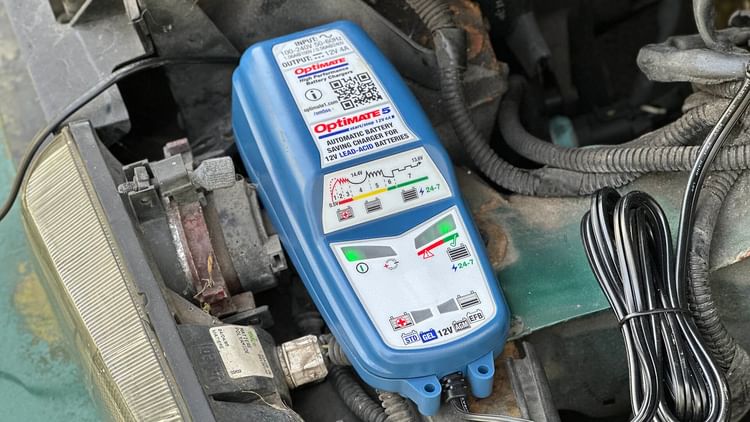
Modern cars are very good at flattening their own batteries.
Not deliberately, obviously. But between start-stop systems, short journeys and the way most of us actually use our cars – especially classics – it doesn’t take much for a battery to start feeling a bit sorry for itself. Leave something parked up for a couple of weeks and you’re already wondering whether it’ll wake up like you after a shot of Berocca or with all the enthusiasm of a teenager on study leave. That slight sense of dread creeps in, even if it’s June.
That’s where something like the OptiMate 5 Start/Stop comes in. It’s not going to revive that Motorcraft battery that’s been gathering dust in your garage since 1987, but it will prevent it from getting to that point in the first place.
But first, a bit of confusion. Depending on where you look, this is either a Bronze or Silver series product. The box says one thing, the website another. In reality, it seems to be the same charger wearing slightly different clothes. Petrolblog’s is Silver, so clearly we’re more important than someone with a Bronze charger.
Disclosure
This is based on actually using it over a few weeks, on a mix of batteries – one in a Fiat Coupé that doesn’t get used as much as it should, and a couple of much older ones doing a fairly thankless job elsewhere.
No lab coats, no controlled conditions – just how it works in normal life.

Product summary
The OptiMate 5 Start/Stop is a 12V smart charger aimed squarely at car batteries, including AGM types used in start-stop systems. With a 4A output, it sits above the basic trickle chargers and is designed to do a bit more than just shove charge in and walk away.
The idea is that it charges the battery, checks what state it’s in, and then keeps it in good condition. ‘Connect and forget’, as OptiMate calls it. There’s a certain smugness in knowing your car is being fed electricity while it sleeps.
First impressions and setup
It feels reassuringly solid straight out of the box. There’s a slightly old-school look to it – the sort of thing you might have seen hanging up in a motor factors in about 1998 – but that’s not a bad thing. If anything, it gives the impression it’s here to do a job rather than win a design award.
It’s also nicely manageable. You can hold it in one hand, it’s not cumbersome and it’s easy enough to chuck in the boot or even a glovebox if you’re going away and want it with you.
The power lead is about 180cm long, which is fine… up to a point. In practice, it means you’ll need to park fairly close to a socket, or accept that an extension lead is probably part of the deal.
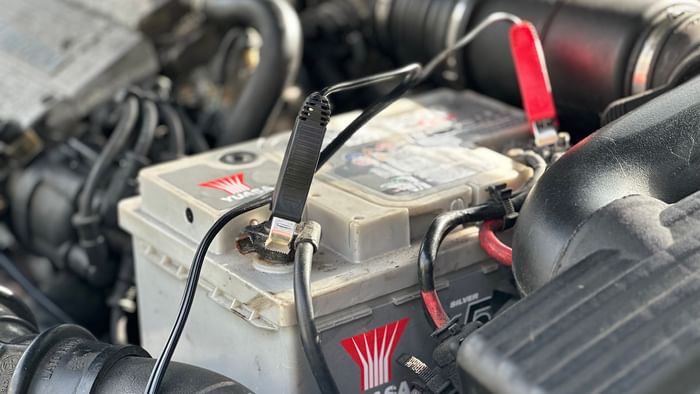
The leads themselves are the same length whether you’re using the crocodile clips or the permanent battery connector, which keeps things simple but doesn’t really give you any extra flexibility either way.
In use
Using it is refreshingly uneventful.
There’s no noise, no heat, no sense of drama. You plug it in, connect it up, and it simply gets on with the job. In a world where even the most basic gadgets try to put on a bit of a show, there’s something reassuring about that.
The LEDs are straightforward enough, although not completely obvious at first glance. You’ll probably check the manual once to work out what’s going on, and after that you get the hang of it. From then on, it’s mostly a case of trusting that it’s doing something sensible in the background.
On the Fiat that had been sitting unused for a couple of weeks, it brought the battery back up to full charge within an afternoon, and by the time I came back to it, it had already moved into a maintenance mode. Good stuff. One less potential electrical issue to worry about – always a bonus when you own something Italian.
Real-world limits
It’s not magic, though.
Two much older batteries we use for electric fence posts – which have had a fairly hard life – were beyond its abilities. Despite the claim that it can recover batteries from as low as 4V, it couldn’t get these back into service, and we ended up using a different charger to push some life into them.
That said, those batteries are likely well past their best anyway. It feels less like a failure and more like a reminder that this is a charger designed to maintain and sensibly recover a battery that’s still fundamentally usable – not bring something back from the dead.

Price and value
With an RRP of around £80, and fairly easy to find for closer to £70, it sits in a sensible middle ground.
You can absolutely buy cheaper chargers that will put some charge into a battery for half the money, and you can spend more on something a bit slicker from brands like CTEK. Not cheap enough to make you think twice before pressing the ‘add to cart’ button, but expensive enough to make you think twice about ordering a takeaway pizza this weekend.
It’s also worth remembering that it’s more affordable than a new battery. If it helps you avoid replacing one early – or saves you from being stranded somewhere inconvenient – it doesn’t take much to justify the cost.
Petrolblog real-world aside
There’s something oddly satisfying about it.
It’s not exciting, and you won’t find yourself looking for excuses to use it, but it does remove a small layer of background worry. You plug it in, leave it alone and come back to a car that’s ready to go.
In that sense, it feels less like a gadget and more like preventative maintenance – the sort of thing you don’t think about until you’re glad you did, and preferable to thumbing a lift to Halfords at 3pm on a Sunday afternoon.
Early verdict
The OptiMate 5 Start/Stop isn’t especially flashy, and it doesn’t entirely help itself with slightly confusing branding. What it does do is work, and work well, in the sort of situations most people will actually use it for. It keeps a healthy battery in good shape, helps a slightly tired one along, and gets on with things without fuss.
Just don’t expect miracles if the battery is already beyond saving.