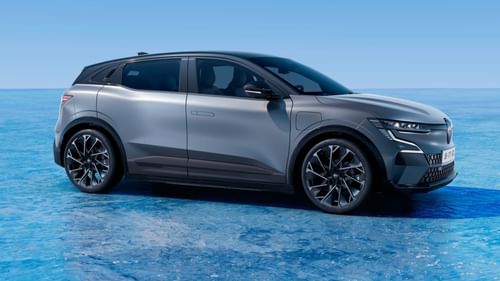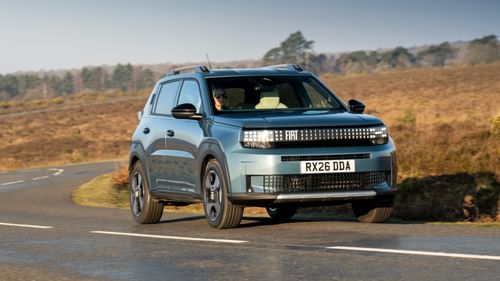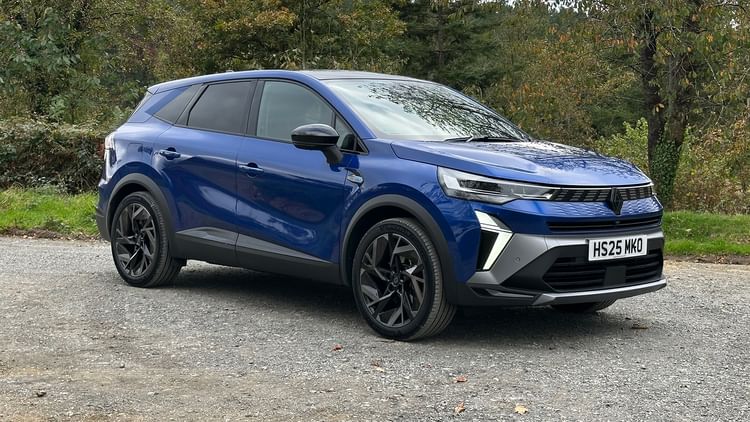
The Symbioz arrives on the driveway with the enthusiasm of a substitute teacher taking over a class that really, really liked the old one. In this case, that substitute has to follow ‘my’ beloved Renault Rafale: the modern Safrane, the car that confused the public, delighted the faithful, and somehow made me feel like a minor French dignitary every time I drove it.
Note: These updates are in reverse order, because that’s how the internet works. So if you want to read about the Symbioz's ‘different second album’ syndrome before its grand entrance, you’re in the right place. Scroll down if you’d rather start from the top… which is actually the bottom. You get the idea.
Final update: April 2026 – 11,437 miles
Six months and around 10,000 miles later, I’m still not entirely sure where the Renault Symbioz fits into the automotive landscape. Which, in fairness, probably tells you everything you need to know about modern family cars.
Not long ago, people worried about a fuel crisis drove diesel hatchbacks and spent weekends arguing about the merits of a Peugeot 406 HDi over a Mondeo TDCi. Now we all drive crossovers with ambient lighting and touchscreen menus while watching diesel flirt with £2 a litre and pretending this is perfectly normal behaviour from society.
At least the Symbioz has one thing firmly in its favour: it’s extremely good on fuel.
Ahead of a 350-mile round trip to Worcestershire, I decided to see what would happen if I stopped driving like somebody trying to make progress on the M5 and instead fully embraced the car’s Eco mode. Normally I ignore these settings because they tend to turn modern cars into wheeled beige cardigans, but the Renault surprised me.
Eco mode alters the throttle response, gearbox strategy and cruise control settings in the name of efficiency, while also turning half the cabin green so you know you’re officially saving the planet. With the cruise control set at a steady 70mph – and an inevitable 50mph through several miles of roadworks – the Symbioz settled into motorway life remarkably well.
Interestingly, the M5 felt slower than usual. Whether it’s rising fuel prices or collective national exhaustion, there seemed to be fewer people blasting along at 90mph in leased German SUVs. Admittedly, this was offset by the usual collection of middle-lane philosophers.
By the time I arrived in Worcester, the Symbioz was claiming a range of almost 700 miles after a refill. Naturally, achieving the official 64.2mpg in real-world driving still feels about as realistic as finding an unmodified Saxo VTR, but the Renault has genuinely impressed me with its economy. Over six months, it averaged 54.7mpg, rising to 63mpg since the previous update. Those are proper diesel numbers, achieved without the soundtrack of a distant cement mixer.
Not that Renault’s technology is entirely flawless.
The car regularly scores your driving for economy and safety, which sounds harmless enough until you realise the safety score depends heavily on the speed limit recognition system correctly identifying road signs. Mine doesn’t.
After another trip up the M5, driven with all the enthusiasm of a man transporting soup, the Symbioz rewarded me with a safety score of 48 out of 100. Apparently, leaving a 50mph roadworks section near Taunton without the car noticing the national speed limit sign meant it believed I’d spent the next 100 miles driving 20mph over the limit. Which feels slightly unfair.
That neatly sums up life with the Symbioz, really. It’s competent, economical, comfortable and impressively easy to live with, but there’s very little about it that stirs the soul. During its first month, it immediately found itself drafted into regular long-distance hospital runs and daily duties, covering around 3,000 miles almost without complaint. Since then, it has quietly dealt with the realities of modern life: shopping trips, motorway journeys, family logistics and endless rural Devon grime.
And perhaps that’s the point.
The Symbioz doesn’t really have a USP beyond being another well-equipped family crossover in a market already overflowing with them. It doesn’t possess the slightly oddball charm of some old Renaults, nor the sense of occasion you get from the Rafale. I suspect that in a few years’ time I’ll remember the Rafale vividly, while the Symbioz will blur into the general crossover-shaped background noise of the 2020s.
But most buyers won’t care about that in the slightest.
What they’ll get is a car that’s comfortable, practical, economical and packed with equipment, particularly in Iconic Esprit Alpine trim. It’s easy to drive, cheap to run and entirely painless to own. Sometimes that’s enough.
March 2026 – 9,350 miles
Five months into life with the Renault Symbioz and it’s the smaller things that are starting to stand out. Not the headline features, just the sort of details you notice when parking at Waitrose or wondering where you last left your sunglasses.
Starting with parking, because the Symbioz is nothing if not attentive. The sensors are a bit too keen, sometimes warning about things that feel further away than they really are, or making a space seem tighter than it is. That said, it’s probably better that way, especially around here where you’re never far from a stone wall or something that looks like it’s been working on a farm.
The reversing camera is less impressive. The image quality is surprisingly poor, lacking the clarity you’d expect in a car like this. It’s not unusable, but it does feel a bit dated. The 360-degree view helps, though, and is genuinely useful when you’re trying to squeeze into a space.
Inside, there are a few nice touches. The wireless charging pad, tucked away beneath a shelf, works well. You don’t have to line your phone up perfectly for it to charge, and because it’s out of sight, you’re less tempted to keep picking it up while driving.
There are plenty of charging options elsewhere too. Four USB-C ports – two in the front and two in the back – should be enough for most situations, especially on longer journeys.
Storage is a bit more of a mixed bag. There’s no proper sunglasses holder, which feels like something this kind of car should have. There is a slim slot under the centre console that does the job instead. It’s not ideal, but it works, and at least I now know where my shades are.
The Harman Kardon stereo, fitted to this Iconic Esprit Alpine model, is another plus. It sounds good whatever you’re listening to, whether that’s music, a podcast or the sat-nav trying to find a way around roadworks.
Rear-seat passengers get the Solarbay panoramic roof, which helps make the back feel a bit less enclosed. Headroom isn’t especially generous, though – my eldest isn’t a fan – and the sloping roofline combined with the dark rear glass can make it feel a bit gloomy. The adjustable roof does help with that, letting in more light when needed.
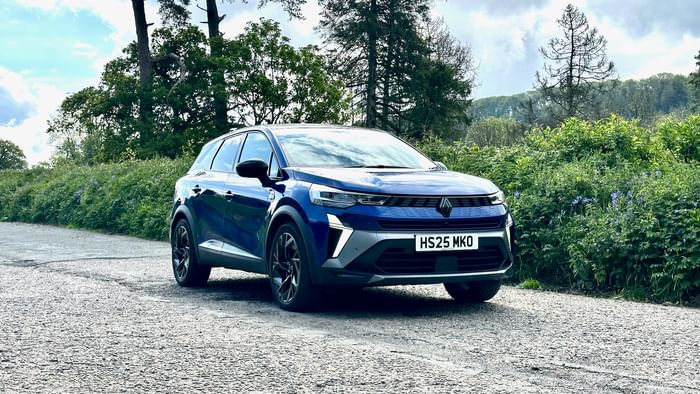
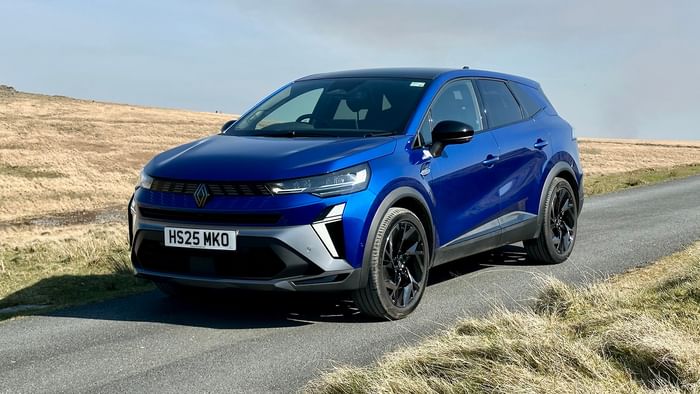
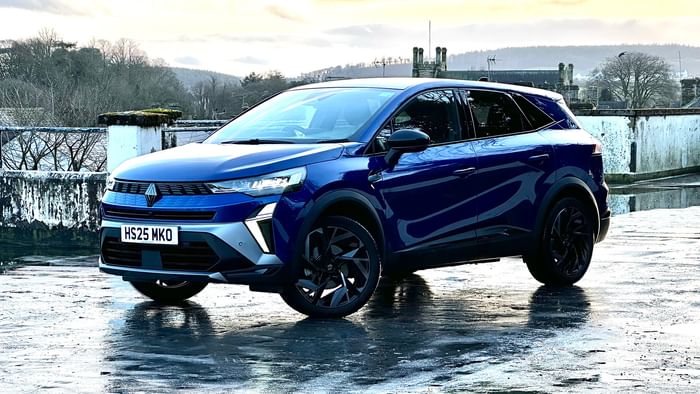
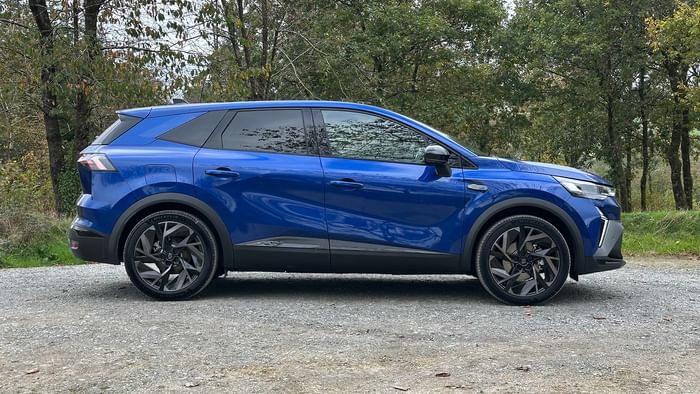
And finally, the paint. This car’s optional Iron Blue finish (not to be confused with Irn-Bru) looks great when it’s clean. The problem is keeping it that way. Over the past five months it’s rarely stayed that way for long, thanks to winter weather and rural roads. With spring on the way, there’s a chance it might stay clean for a bit longer.
February 2026 – 8,032 miles
The Renault Symbioz has a habit of making itself heard. Not because it’s especially loud, but because its hybrid system occasionally feels determined to remind you it’s there.
Under the bonnet is a 1.8-litre petrol engine paired with a 48bhp electric motor and a 20bhp starter-generator, combining for 158bhp. On paper, that sounds like a sensible, well-balanced setup, and most of the time it is. Every now and then, though, it behaves like a driver who’s missed the cue to change gear.
There are moments when it hangs onto a ratio longer than feels natural, the engine note suggesting it should have shuffled up already. Other times – particularly when rolling downhill – it’ll drop a gear when you expect it to glide along in electric mode. It’s not a fatal flaw and you quickly adapt to its logic, but it does make you wish for a little manual intervention now and again.
Where Renault absolutely nails things is inside the cabin.
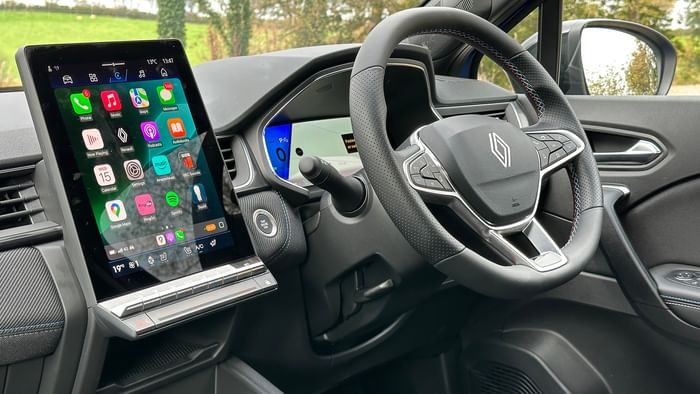
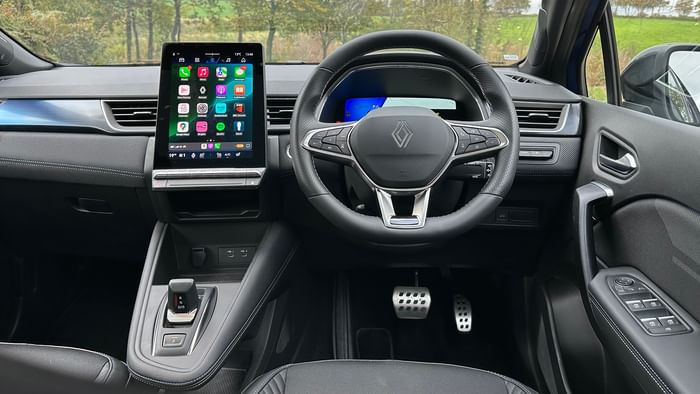
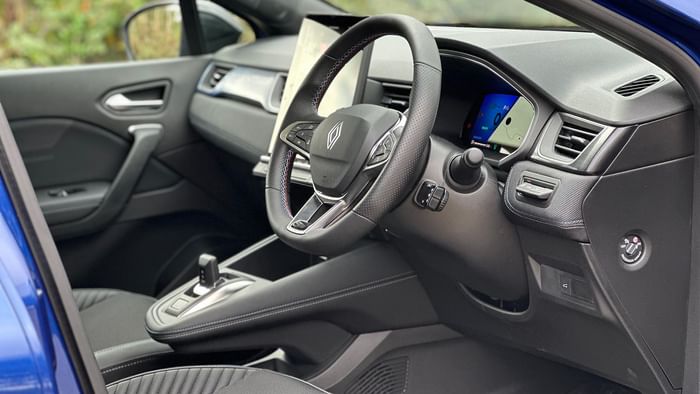
Long-time readers will know I’ve been banging on about Renault’s infotainment setup for a while now, and the Symbioz only reinforces that view. The 10.4-inch touchscreen is clear, responsive and – crucially – doesn’t bury everything three menus deep like some sort of digital escape room. Even better, Renault has resisted the industry-wide urge to delete physical controls, so heating and ventilation still get proper buttons. Revolutionary, apparently.
The Google-based system remains one of the better integrations out there, and switching between it and Apple CarPlay is refreshingly painless. There’s also a lovely bit of Renault continuity hiding behind the steering wheel: the familiar remote audio control pod, evolved but instantly recognisable if you’ve ever spent time in anything from a Renault 25 onwards. In a world obsessed with reinventing interfaces every five minutes, it’s nice to see something quietly stick around because it works.
Not everything is perfect in tech land, mind. One morning the driver display simply decided it had had enough and went completely blank. No speed readout, no warning lights, no fuel gauge – just a black panel where information should have been. I improvised by glancing at the navigation display for my speed, but it’s hardly a long-term solution. Experiences like this do make you wonder whether analogue dials will eventually come back into fashion, heralded as the next big innovation by people who’ve just rediscovered them.
To end on a more positive note, there’s Renault’s keycard: now something of a modern classic in its own right. A quarter of a century after the Laguna II introduced hands-free access to the mainstream, the concept still feels clever: keep the card in your pocket and the car unlocks as you approach, then locks itself as you walk away. Simple, effective and one of those features you stop noticing until you drive something without it.
The Symbioz even has a dedicated storage slot for the keycard, although mine rarely sees it. Instead, the compartment has become home to a tin of Smints, which fits almost perfectly. Whether Renault intended that or not is unclear, but it feels like a quietly brilliant piece of everyday practicality.
January 2026 – 6,875 miles
One thing that genuinely surprised me this month was discovering that, when assessed by Euro NCAP in 2024, the Renault Symbioz emerged with a four-star rating rather than the full five. That surprise only grew when I realised that Renault hasn’t managed a maximum score across its mainstream range since 2022. The Captur, the new 4 and 5 E-Tech models, and most recently the Clio have all fallen just short of the showroom-friendly benchmark.
This feels a long way from the early-2000s glory days, when a five-star rating seemed almost a Renault birthright. The Laguna II famously became the first car ever to score five stars in 2001, followed shortly afterwards by the Mégane II, which did the same for the family hatchback class. Back then, Renault wasn’t just chasing safety standards, it was setting them.
That said, the Symbioz doesn’t so much fail Euro NCAP as miss the excellence Renault once defined. Structurally it’s sound, child protection scores are reassuring, and the active safety systems do their job competently. The issue is a collection of marginal shortfalls: repeated chest-protection scores that just miss the mark, the absence of far-side impact mitigation, and a handful of safety technologies that are now becoming expected rather than optional. The result is four stars – respectable, but no longer headline-worthy.
I should probably confess at this point that I don’t worship at the altar of Euro NCAP. I’ve long believed buyers should look beyond the star rating and avoid making big financial decisions based purely on five yellow stars. In the Symbioz’s case, it’s less about a lack of protection if the worst happens, and more about missing a few electronic safety nets designed to stop you getting into trouble in the first place. Besides, I switch off many of the driver assistance systems as soon as I get in anyway.
That’s thanks to Renault’s ‘My Safety’ button, positioned conveniently on the right-hand side of the dashboard and pressed instinctively before I’ve even thought about adjusting my seat. In fact, I press it twice in quick succession to activate my personalised ‘My Safety Perso’ setting: a mode that silences most of the beeps, bongs and moralising reminders that you’ve strayed a millimetre too close to a white line or exceeded a speed limit that the car has almost certainly misread. I’m not condoning speeding; it’s just that the system remains deeply convinced you can do 80mph down Old Bond Street and 20mph on the M5. The one lingering irritation is that all of this resets every time you switch off the ignition, meaning the ritual begins anew on your next journey.
Speaking of rituals, let’s talk buttons. You may remember my frustration with the Rafale’s reluctance to let you activate the heated steering wheel without a small battle. Well, that appears to be a Renault-wide character trait, because the Symbioz behaves in exactly the same way. Four presses is the norm, as though the car wants you to really reflect on whether warm hands are necessary on the way to Waitrose. Curiously, if you’ve only switched the engine off briefly, the heated steering wheel light often remains illuminated when you return. The heated seats, however, do not, presumably because consistency would be far too easy.
As the Symbioz has settled into a calmer phase of life, its usage has shifted towards shorter, more urban journeys and less time cruising in top gear. That may help explain a slight dip in fuel economy, although increased use of accessories, passengers in the back and luggage in the boot will also play their part. The Christmas period highlighted two further truths: three young adults don’t appreciate being squeezed into the rear seats, and the boot is large enough to swallow eight sizeable bags of goat feed – though, regrettably, not at the same time.
If nothing else, that feels like a very Renault way to start the year.
December 2025 – 6,027 miles
There was always a risk that the Renault Symbioz would feel like a step down after seven months with the Rafale. A mid-range family SUV is never going to sparkle quite as brightly after life with Renault’s flagship; a car that managed to feel special even when doing entirely dull things like sitting in traffic or waiting for a flat white at a motorway services.
I promise this really is the last time I’ll mention the Rafale (probably), but it’s worth acknowledging the sense of loss. Think of it as a quick-fire Generation Game conveyor belt of things I miss: rear cupholders, a rear centre armrest, grab handles, a sunglasses holder, that richer interior feel, the absence of a fuel filler cap, and the steering column-mounted gear selector. Then the bigger stuff: four-wheel steering, the amount of time it spent running silently in electric mode, and that intangible sense of occasion. None of this is especially fair – the Symbioz is smaller, cheaper and has a much more modest battery – but it does mean it’s fighting a classic case of ‘difficult second album’ syndrome on my driveway.
That said, I do like the Symbioz. More than I perhaps expected. The fuel economy is better, it’s surprisingly more entertaining on a B-road than its Captur-estate silhouette suggests, and the smaller footprint makes it far less stressful in the real world. This was brought home during a recent trip into central London for a Guild of Motoring Writers awards do (ooh, get me!), which involved parking in Mayfair and threading through the chaos of the capital’s shopping district. Watching brand-new Range Rovers and Land Rover Defenders being nervously piloted through Regent Street’s soup of buses, delivery scooters and influencers felt faintly absurd. I was very glad to be in something that didn’t require naval-style navigation charts.
Of course, being smaller doesn’t make it invincible. After 15,000 largely blemish-free miles in the Rafale, the Symbioz has already picked up some irritating scrapes near the fuel filler. I’m fairly sure they were inflicted by a pick-up truck in the tight confines of Exeter hospital car park, during a period when I was taking whatever space I could find and worrying about rather bigger things. It’s not my fault, but that doesn’t make it any less annoying.
More irritating still is that some familiar Renault electrical gremlins have arrived earlier than they did in the Rafale. There have been the occasional phantom alarm, a ‘service required’ warning that appears and disappears at will, moments when parts of the digital instrument display freeze, and the odd refusal from the infotainment system to produce any sound at all. The speed-limit recognition continues to live in its own parallel universe (no, I don’t think 80mph along Old Bond Street or 20mph on the M5 is correct), and the windows mist up more often than expected, sometimes requiring the blowers to be set to full blast. I’d tolerate that in my 1997 Toyota Camry, but in a brand-new Renault, it feels less forgivable.
Thankfully, the practical side of the Symbioz continues to impress. The boot is genuinely useful, offering 492 litres as standard or a very handy 624 litres with the sliding rear seats pushed forward. The height-adjustable boot floor is one of those small features that makes daily life easier; ideal for muddy wellies, damp coats, or preventing a week’s worth of Waitrose shopping from performing acrobatics on the way home.
So where does that leave the Symbioz? It may not have the Rafale’s flair or sense of occasion, but it’s starting to make a strong case for itself as a dependable, economical and easy-to-live-with family SUV. It’s not the car you fall in love with at first sight, but it might just be the one you quietly come to appreciate.
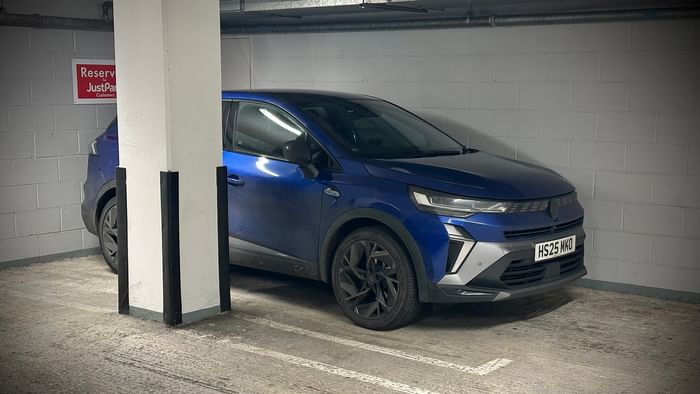
Note: The photo below is the only one I took on my nine-hour round trip to Mayfair. I got changed into my dinner suit behind that pillar, which wasn't my most dignified moment. On the plus side, I later discovered that the car park is notorious for break-ins, so I was just grateful to escape without a smashed window – even if I left my dignity on Old Burlington Street.
Original post: How do you follow a car like the Rafale?
The Symbioz has its work cut out. It’s not meant to replace the Rafale in spirit or status, but if you live with something for months and develop feelings you can’t explain to non-French-car people, comparisons happen whether Renault likes it or not.
And on first acquaintance, the Symbioz doesn’t so much shout for attention as quietly slip into the room, apologise for being late and ask where it should sit. Renault’s SUV range is now so crowded that the Symbioz risks being elbowed aside by its own siblings, and from certain angles – particularly the front – it’s basically a Captur wearing platform shoes. Tom Wiltshire even labelled it ‘an estate version of the Captur’, which is either damning or accurate. Probably both.
But Renault loves a practical, slightly oddball family car, and the press release leans heavily on heritage by referencing the Renault 16 and the original Espace. Say “Renault 16” to me and I’m immediately picturing plush cloth seats, a hatchback before hatchbacks were cool, and the faint smell of a Gauloises smouldering in the ashtray.
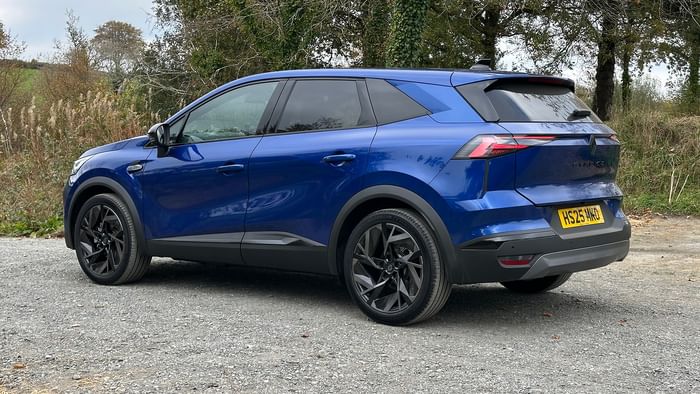
The Symbioz first surfaced in 2024, but this is the lightly-freshened 2026 edition. Under the bonnet lives a new 1.8-litre petrol engine (158bhp), paired with a slightly beefier hybrid system and a bigger battery. There’s a new motorway mode in the transmission that promises quieter cruising, though you’d struggle to get excited about it unless your hobbies include gear ratios. There’s also a new e-shifter, which looks nice enough but mainly exists to remind you that Renault once spent a ridiculous amount of time and money on the Avantime's double-folding door hinges, and we're unlikely to see such madness again.
‘Mine‘ is the flagship Iconic Esprit Alpine trim, so that's Baccara to us. Equipment levels are satisfyingly excessive: twin big screens, Google built-in, a Harman Kardon hi-fi, ambient lighting that makes the interior look like a nightclub in Lyon, and the Solarbay opacifying roof, which is still one of Renault’s best modern inventions (until it goes wrong). There’s heated everything, a hands-free keycard (a tiny dose of Laguna nostalgia) and precisely one option: Iron Blue paint. That’s it. Renault has finally made a new car that you can configure in less time than it takes to find a parking space at Carrefour.
Practicality is one reason you might choose the Symbioz over the Captur. The sliding rear bench is a lovely nod to Renaults of old – a bit Twingo, a bit ZX (yes, Citroën, but still French and therefore allowed). Slide it forward for a massive 624-litre boot, slide it back for legroom rivalling a Vel Satis. It’s clever, flexible and exactly the kind of feature mainstream buyers will never notice but Petrolblog readers will coo over. Less impressive: no rear armrest and no cupholders. A family SUV with nowhere for back-seat drinks? That’s very Renault – almost reassuringly so. I'm surprised it doesn't have manual rear windows, Safrane Executive trim style.
The car arrived at a chaotic time, so the Symbioz was thrown into service immediately: Exeter, Bristol, endless A-road trundling, M5 stretches, hospital car parks, and the sort of suburban crawling that makes you question your life choices. I racked up nearly 3,000 miles in a matter of weeks. And here’s the thing: it’s been faultless. Around 55mpg, quiet on the motorway, and so undramatic to drive that it lets you think about more important things and not worrying about Bristol’s Clean Air Zone.
Is it a step down from the Rafale? Of course it is. The Rafale had presence, soul, charisma – it was a Safrane for the 2020s: exclusive, misunderstood, slightly absurd. The Symbioz is smaller, more sensible and (whisper it) a bit ordinary. But it’s also easier to park, easier to drive economically, and feels absolutely unshakeable when you need a car to just get on with it.
My only real complaint so far is the reversing camera, which looks like it’s being broadcast from a Sega Dreamcast.
First impressions? Quietly positive. Sensible, dependable, practical: a Captur with a bit more brain and a bit more boot. But can it do enough to stand out in Renault’s overcrowded SUV school photo? We’ll find out over the next few months.
What the professionals say about the Renault Symbioz
Petrolblog is running the Renault Symbioz for Diesel&EcoCar magazine until the middle of April 2026, so get in touch if you have any questions or would like any specific information on the car.
Stay tuned for the first update. In the meantime, here are some quick reviews from the proper websites, along with the price, performance and economy figures.
- Autocar: Despite a few rough edges, the Symbioz is a refined, spacious and well-priced family-focused mid-size SUV
- Auto Express: The Renault Symbioz is an attractive offering for family buyers, and should be a very easy car to live with – 4 (out of 5)
- Carwow: The Renault Symbioz is practical and super-efficient, but unless you need the extra boot space you’d be better off with a Captur – 8 (out of 10)
- Heycar: Smart and economical new Qashqai rival – 7 (out of 10)
- Honest John: Strong value, excellent economy, a smart cabin and perfectly acceptable ride and handling make for a capable all-rounder, with just a hint of style – 4 (out of 5)
- Parkers: The Renault Symbioz is a mid-size hybrid family SUV that may seem a bit superfluous when you first glance its way – 4 (out of 5)
- Top Gear: The Symbioz is a perfectly fine family runabout, but lacks a little sparkle in an ever-crowded sector – 6 (out of 10)
- What Car?: The Symbioz is a compact family SUV that’s keenly priced and offers impressive efficiency – 2 (out of 5)
Renault Symbioz E-Tech hybrid 160 Iconic Esprit Alpine specification
Price: £33,795
Price as tested: £34,545
Options: Iron Blue metallic paint £750
Engine: 1798cc 4-cylinder turbo, petrol, plus two electric motors
Battery: 1.4kWh
Transmission: 6-speed automatic (four gears plus two additional motors)
Max power: 158bhp
Max torque: 260Nm
Max speed: 105mph
0-62mph: 9.1sec
WLTP range: 683 miles
CO2: 96g/km
Fuel economy: 65.7mpg
Insurance group: 20
Updated 6 May 2026:
The Symbioz finished with around 11,500 miles on the clock. Scroll up for the latest, or scroll down if you’re reading in reverse. Which you are.