Which cars can’t be used for a driving test in the UK?
From the Toyota iQ to the Polestar 5, the DVSA maintains a wonderfully peculiar list of cars that cannot be used for a practical driving test.
Official government guidance isn’t traditionally a rich source of motoring entertainment. Tax. Emissions. MOTs. Driving lessons. Important stuff, granted, but GOV.UK isn’t going to be your destination of choice when you’ve finished doomscrolling on MySpace or Friends Reunited.
The DVSA’s list of cars you cannot use for a driving test is different. It features the Toyota iQ, the Smart Fortwo, any panel van, four convertibles, a pair of Polestars and a partridge in a pear tree.
Which cars can't be used for a driving test?
The reason isn’t particularly entertaining; the DVSA points out that ‘some cars cannot be used in the test because they do not give the examiner all-round vision’. Fair enough.
But the list itself is a bit... odd.
- Any panel van
- BMW 218 convertible
- BMW Mini convertible
- Ford KA convertible
- Polestar 4
- Polestar 5
- Smart Fortwo (2-door)
- Toyota iQ
- VW Beetle convertible
The cars themselves aren’t especially odd. It’s the way the DVSA describes them – and the fact that they’ve ended up together – that makes the list so peculiar. The DVSA goes on to say: ‘There might be other cars that you cannot use. This is because not every model has been used in a test before, and some may not give the examiner all-round vision.’
In other words, don’t turn up in your Countach without checking first and expect the examiner to welcome you with open arms. A Lotus Exige? Probably best to phone ahead.
Why are these cars banned from driving tests?
Let's examine some of the DVSA's hit list in more detail.
Any panel van
This one is fair enough, although the DVSA adds the following in brackets: ‘cars without rear seats or rear side windows’. That rules out the likes of the Vauxhall Corsavan, Ford Fiesta SportVan and, rather sadly, the bonkers MG Express.
BMW 218 convertible
The BMW 218 convertible seems both oddly precise and technically incorrect. A member of Pedants’ Corner will point out that it should be the BMW 218i, but why not use the catch-all BMW 2 Series Convertible? Presumably nobody has turned up for their test in an M235i or M240i.
BMW Mini convertible
‘BMW Mini’ is another delightfully imprecise and rather dated name. BMW has spent more than two decades presenting MINI as a brand in its own right, complete with capital letters, lifestyle accessories and showroom furniture. The DVSA has other ideas. To officialdom, it remains the BMW Mini convertible.
The guidance does not specify a generation, model year or whether the restriction applies only when the roof is raised. The likely problem is the view past the substantial rear pillars and rollover protection, rather than an institutional objection to oversized circular speedometers or Union Jack rear lights.
Ford KA convertible
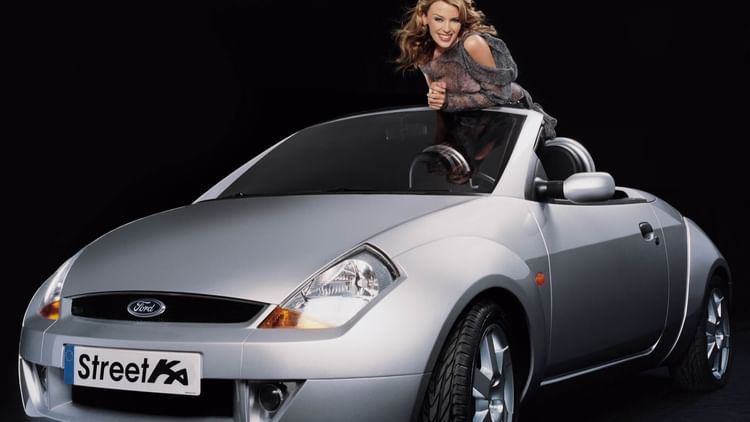
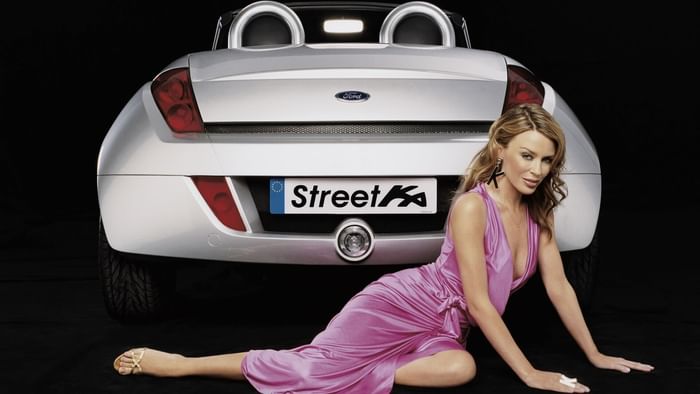
This one is better known as the Ford Streetka. Built between 2003 and 2005, the Streetka was based on the original Ford Ka and designed in concept form by Ghia, engineered and built by Pininfarina, and endorsed by Charlene from Neighbours.
The DVSA’s ‘Ford KA convertible’ might lack the pizzazz of Streetka, but it removes any possible doubt about which part of the car causes the difficulty. With the roof raised, the rear quarters leave the examiner with a restricted view. Turn up in a Sportka and you should be fine – and the journey to the test centre will be more fun.
Polestar 4 and 5
At the opposite end of the market sit the Polestar 4 and Polestar 5. Both dispense with a conventional rear window, relying instead on a camera and digital mirror to show the driver what is happening behind. That’s great for the person behind the wheel, but less helpful to the examiner sitting in the passenger seat.
This makes the Polestars two of very few cars that could be too technologically advanced for a driving test. It also means they share an official government list with the Streetka, which is unlikely to appear in many Polestar press releases (although the company might appreciate a nod from Kylie).
Smart Fortwo
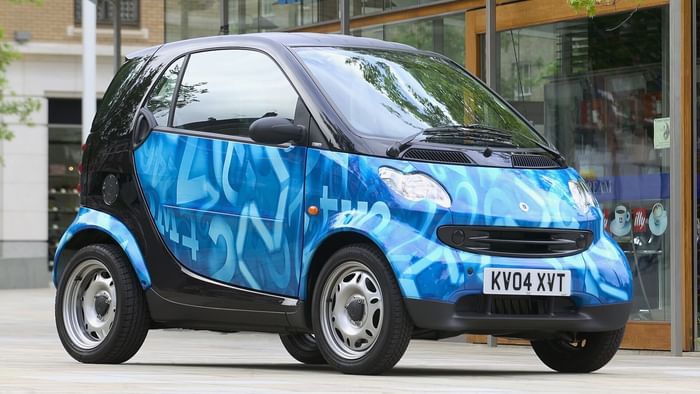
The parenthetical ‘2-door’ is useful if you are prone to confusing the Fortwo with the four-door Forfour, but otherwise feels slightly unnecessary. The clue is in the name: the Fortwo was designed for two people and has always had two side doors. Once again, the problem is the examiner’s view rather than the car’s suitability for a learner. The Smart’s tiny dimensions should make manoeuvres relatively straightforward, but its rear bodywork and pillars restrict what can be seen from the passenger seat.
Toyota iQ
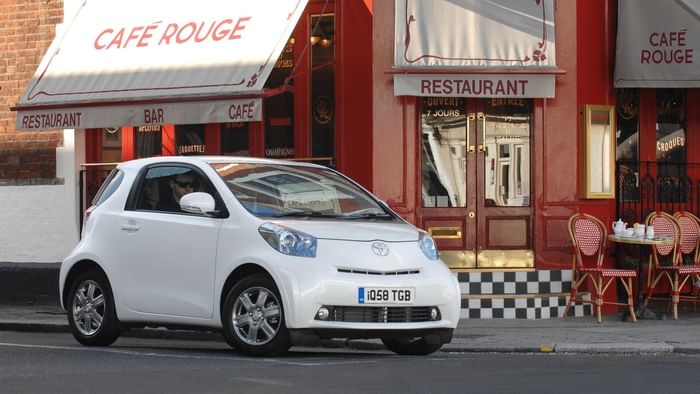
The Toyota iQ is arguably the strangest member of the group. Unlike the convertibles, it has a fixed roof and a conventional rear window. Unlike the Polestars, it doesn’t replace glass with a camera. It is also remarkably small, making it look like an ideal car in which to tackle a practical driving test.
Its clever packaging may be part of the problem. The asymmetrical dashboard allows the front passenger to sit further forward than the driver, creating space for a third adult behind. Combined with the iQ’s thick rear pillars and tiny rear side windows, this leaves the examiner with an inadequate view.
There is another question: if the Toyota iQ cannot be used, what about the Aston Martin Cygnet, which was essentially an iQ in an expensive suit? The Cygnet is not named on the list, but the DVSA warns that the guidance is not exhaustive. Perhaps nobody has yet arrived for a driving test in an Aston Martin Cygnet. If they do, Petrolblog would very much like to hear about it.
VW Beetle convertible
Finally, we have the ‘VW Beetle convertible’. The DVSA does not specify whether this means the New Beetle Cabriolet launched in 2003, the later Beetle Cabriolet introduced in 2013 or both generations.
Either way, the issue is likely to be familiar to anyone who has driven a four-seat convertible with the roof raised: thick rear pillars and a restricted view over the shoulder. What might be an inconvenience for the driver is sufficient to prevent an examiner from conducting a test.
Where this leaves the VW T-Roc Cabriolet and, shudder, the Range Rover Evoque Convertible is less clear. The DVSA advises checking before attempting to use any convertible, although turning up in the latter should arguably earn you a minor fault before the test begins.
Can you use a coupé for a driving test?
The DVSA also says you should contact your local test centre if you want to use a coupé, defined as ‘a car with a fixed roof, two doors and a sloping rear’. Take that, Mercedes-Benz, with your nonsense about a four-door SUV being called a ‘Coupé’.
There are other factors to consider before taking a test in your own car. Tinted windows must be legal – and the test could be cancelled if the rear glass is too dark for the examiner to see through – while rubbish must be removed from the dashboard, footwells, door pockets, cupholders and seats. The remains of last night’s Maccies will be frowned upon.
The car must also be smoke-free, so you’re not allowed to light up a fag immediately before the test.
Certain Citroën and DS models affected by the infamous airbag recall cannot be used unless you can prove that the car is safe. You’ll find the full and potentially changing requirements on the DVSA’s using your own car for your test page.
Still, anyone who turns up for a driving test in a Streetka, Aston Martin Cygnet or 871bhp Polestar 5 deserves some recognition. Maybe not a driving licence, but certainly Petrolblog’s respect.