There are cars you admire, and then there are cars you’re not supposed to criticise. The Peugeot 205 sits firmly in the latter camp. Question it, and you risk being treated like someone who’s just loudly declared baguettes overrated in a Parisian café.
Which is exactly why it deserves a closer look.
Exhibit four: Peugeot 205
Strapline: If you want something sensible, buy an anorak
Factfile:
Production: 1983-1998
Bodystyles: 3- and 5-door hatchback, 2-door convertible, commercials
Engine size: 1,000–1,900cc petrol/diesel
Transmission: 4-/5-speed manual, 3-/4-speed automatic
Number built: 5,278,300
Current status: Flawed and famous
The case for the prosecution
The 205 is sacred and isn’t just a car: it’s a cultural artefact. A wheeled Proustian madeleine that smells faintly of warm, cheap hard plastics and Gauloises. It is the small hatchback, the last great analogue driver’s car, nothing less. The plucky French masterpiece that dances through corners, embarrasses bigger machinery, and single-handedly taught Britain how to enjoy lift-off oversteer while simultaneously crashing into hedges.
Let’s take a look at the evidence.
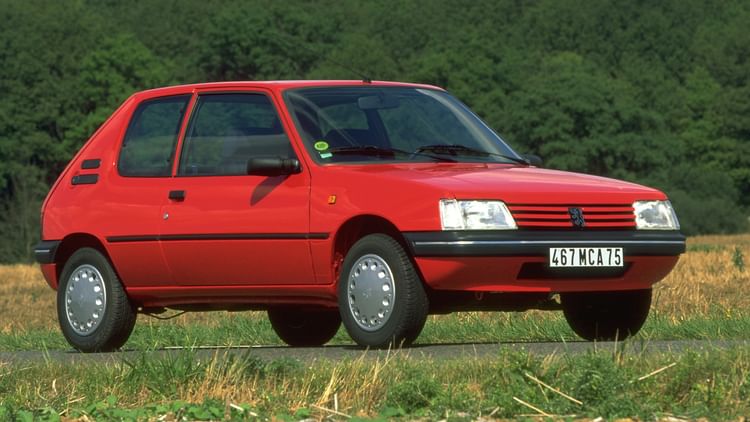
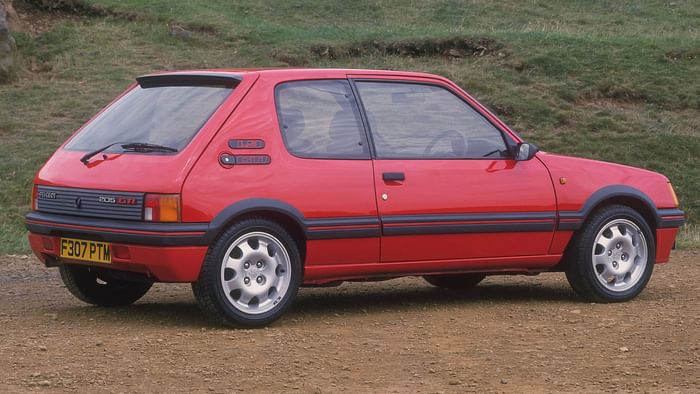
From a distance, the 205 is compact, upright and faintly cheerful. It is not exciting, not offensive, just… there. Compared to the agricultural horrors Peugeot had previously inflicted on Europe, the 205 was practically a supermodel.
The panels appear to have been eye-aligned from across the street. The paint, particularly on red ones, has a habit of fading into a sort of apologetic pink, as if the car itself were embarrassed to be seen in public. Electric gremlins are unavoidable, like death. The 205 taught an entire generation how to interpret flickering dashboard warning lights bearing no obvious relationship to reality.
They behave more like cheap Temu Christmas decorations or a haunted fairground attraction. The 205’s wiring loom was always more a suggestion than a system, with switches operating on vibes. Inside, the 205 offers a masterclass in early-’80s ergonomics, which is to say… none at all.
The driving position is typically French: the pedals are somewhere near your ankles, the steering wheel is at a philosophical distance, and the seat seems designed to encourage a posture last seen in medieval woodcuts.
The hard, shiny, eager-to-rattle (usually in chorus) interior plastics were engineered to age badly. Every surface develops a unique squeak, turning even the shortest journey into an avant-garde percussion concert.
Driving dynamics?
The 205 weighs roughly the same as a croissant and feels like it. Yes, it drives brilliantly… sometimes. On the right road, in the dry, when everything is working.
The steering is alive because there is nothing between you and the front wheels except hope. The suspension is supple because Peugeot accidentally nailed ride compliance while forgetting about body control.
Push it, and the car will rotate eagerly – sometimes heroically, sometimes catastrophically. This isn’t precision handling, but chaos happening to be fun. It is built out of optimism and thin metal. You didn’t so much sit in a 205 as wear it. In a crash, the car would rapidly introduce you to the concept of mortality.
Safety is minimal, structural rigidity theoretical, and crumple zones something Peugeot assumed you could improvise with your knees. The steering is light, talkative and completely uninterested in modern concepts like isolation or refinement. The suspension, especially on humbler models, has a wafty, long-travel quality that makes British B-roads feel like they were designed by someone who cared.
You can fling it into corners with a confidence that would be deeply irresponsible in anything newer. It responds with a Gallic shrug and a bit more grip – not with understeer and a warning light.
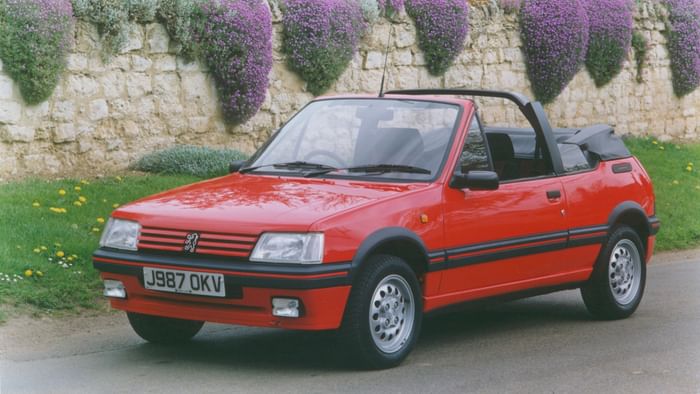
This is where the mythology really begins. Most 205s were bought by people who wanted cheap, economical transport, but Peugeot also made the GTi – which is where the legend becomes untouchable.
The 205 GTi is spoken of as if it were a gift from the gods, rather than a small, twitchy hatchback that demanded respect and punished arrogance with violence. Modern hatches may be heavier and more complicated, but they don’t try to kill you because you lift off mid-corner.
These days, it enjoys near-religious reverence, usually by men who insist that modern hatches are ‘too big’ and ‘too complicated’… while standing next to a poor 205 that has been modified beyond all recognition, in the best Max Power tradition of yore.
Cheap, nasty plastics
That humble Peugeot was once loved by hairdressers, impoverished students and people who’d lost the will to browse German options lists that were as long as a day without bread. Nowadays, it’s even worth more than a decent used BMW.
Faded, discoloured interiors that used to crack if you looked at them too insistently now have ‘patina’. Questionable modifications are ‘period upgrades’. Cars that once survived on scrapyard parts are now too precious to drive in the rain – and prime Festival of the Unexceptional fodder, usually parked next to something beige and British.
A base-model 205 with a lethargic 954cc engine and hubcaps held on by hope is now remembered fondly as ‘honest’ and ‘pure’. In reality, it is slow, noisy and about as safe as a shopping trolley in a hurricane.
Summary
Yet, despite all its faults, the 205 earned its place. It was a product of its time: cheaply made, cleverly tuned and accidentally brilliant in places. What we miss isn’t the car itself, but what it represented: lightness, simplicity and fun without software updates.
It arrived at exactly the right time and was a car you could actually enjoy without needing a second 100-year mortgage or a degree in electronics.
The Peugeot 205 is a reminder of a simpler automotive age – even if it was shoddily built, electrically deranged and ergonomically confused.
The truth is uncomfortable: if the 205 were released today exactly as it was, we’d call it unsafe, unreliable and poorly made. You don’t honour heroes by pretending they were perfect – you honour them by understanding them honestly.
The Peugeot 205 deserves respect, not worship. It was flawed, fragile and occasionally fantastic. A great car then, a nostalgic icon now – and a reminder that the past feels better mostly because it’s over.
Shameless Pb promotion: Order your French tat stickers here.