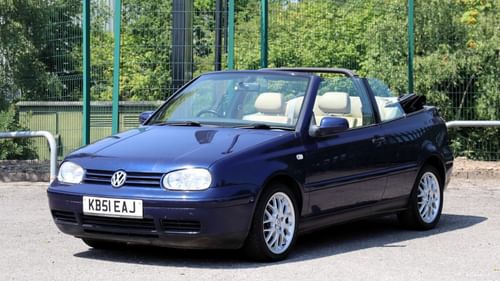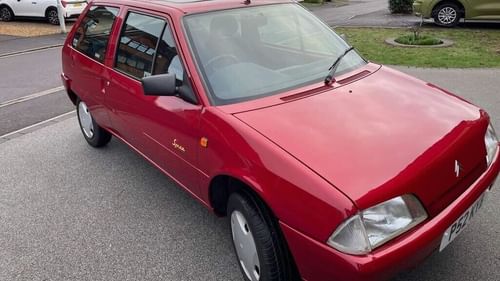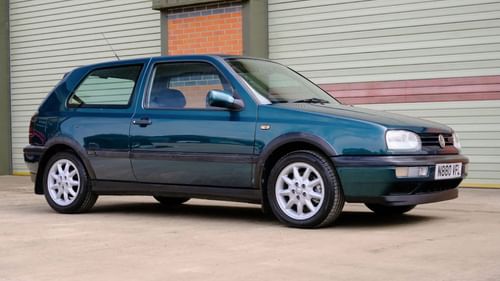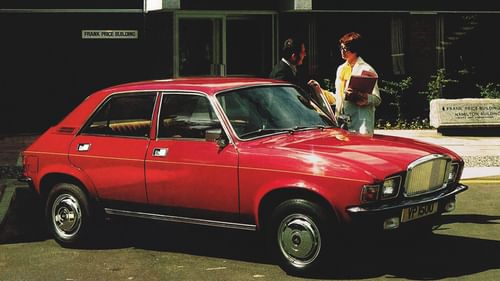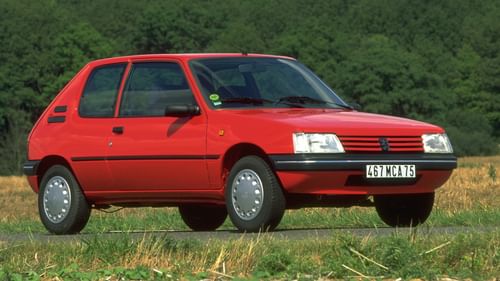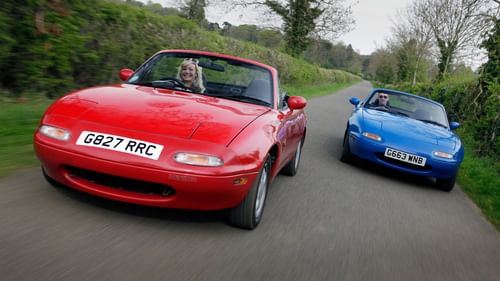
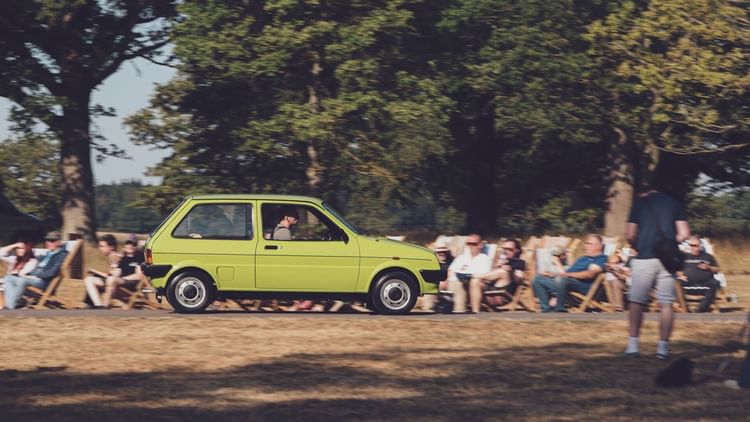
Every summer, somewhere in the English countryside close to Bourne (of BRM F1 fame), on the western edge of the Lincolnshire Fens, Grimsthorpe Castle welcomes thousands of otherwise rational adults who have gathered to celebrate automotive mediocrity.
For one day a year, the Fenland Mountain Rescue Team saves obscure cars from oblivion and the venue brims with a passion normally reserved for Ferraris, Bugattis or obscure alternative Scandinavian jazz festivals. Welcome to the 2026 Festival of the Unexceptional, where the star attractions are vehicles whose greatest achievement was making absolutely nobody look twice in a supermarket car park during their heyday. Forget concours d’élégance; this is a concours d’indifférence.
Here, the judges don’t ask whether the bumper chrome is original; they’re more concerned with original dealer plates or stickers advertising a branch that became a Carpetright in 1993. The true aristocrats of the event are not million-pound classics, but machines that have survived 30 winters, owners called Keith and Trace, an aftermarket Halfords cassette player that went up in flames thanks to bodged wiring, and several unfortunate shades of hearing-aid beige.
Through the gates, 4,500 FOTU fans were greeted by a magnificent sea of 2,500 mediocre and average cars. It resembled the overflow car park of a district council office in 1988, only considerably cleaner. A row of immaculate Nissan Bluebirds – each one different – looked as though a Currie Motors (‘Nice People to Do Business With’, remember?) forecourt had travelled through time.
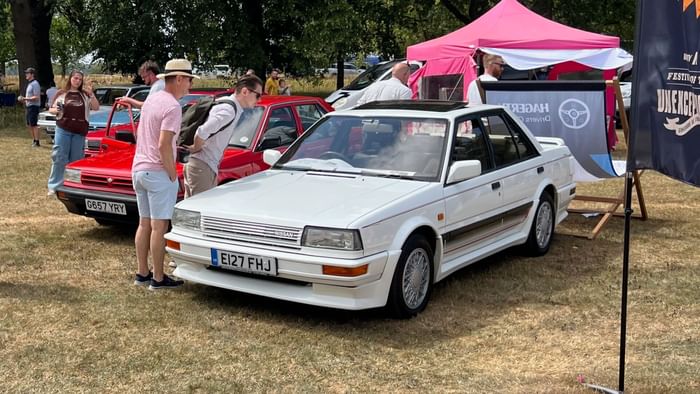
The Bluebird was never designed to excite anyone, just to start every morning and transport stiff-upper-lip accountants without complaint. Most quietly outlived every supposedly superior European rival, ending up as 600,000-mile minicabs. Nissan somehow engineered a car possessing all the emotional charisma of a microwave instruction manual.
Its styling was almost scientifically anonymous. If police eyewitnesses were ever asked to identify one, they would simply report: ‘It appeared to be… a red car.’ Yet today, owners polish every perfectly flat panel with religious devotion. ‘I’ve finally found an original driver’s-side mudflap’ would have the surrounding crowd nodding respectfully; someone might even wipe away a tear.
Nearby, another enthusiast whispers reverently that his particular Bluebird still wears its factory plastic wheel trims, and people applaud.
A unicorn of forgotten ambition
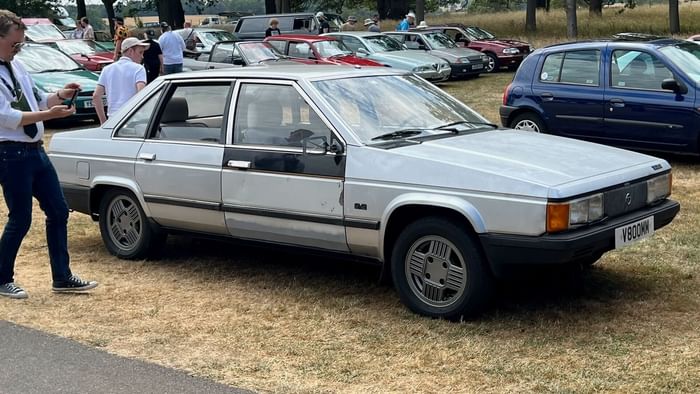
The mighty Talbot Tagora began life as Chrysler Europe’s last-ditch attempt at an executive car, before Peugeot’s takeover stuffed it with parts from the 505 and 604. It was a demonstration of corporate optimism melting into… corporate confusion.
Conceived under one owner, engineered under another and launched just in time for nobody to want it, it remains one of Europe’s greatest commercial disappearing acts. Talbot believed it could compete with executive saloons from Germany, but the buying public politely disagreed.
Seeing one today is rarer than seeing an honest politician. The Tagora itself isn’t actually a bad car, and that’s almost the problem: it’s competent, comfortable and even reasonably handsome, but entirely forgettable. If the automotive world had a witness protection programme, the Tagora would be in it. Its owners possess the quiet confidence of people who’ve spent 20 years explaining exactly what their car is: ‘No, it’s not a Chrysler.’ ‘No, it’s not a Peugeot.’ ‘No, it’s not a Simca.’ ‘Actually, Talbot did exist, and it built this alongside the more mundane Alpine and Horizon.’
After repeating this conversation several thousand times, they achieve a level of patience normally associated with Buddhist monks.
FOTU’s undisputed philosophical masterpiece
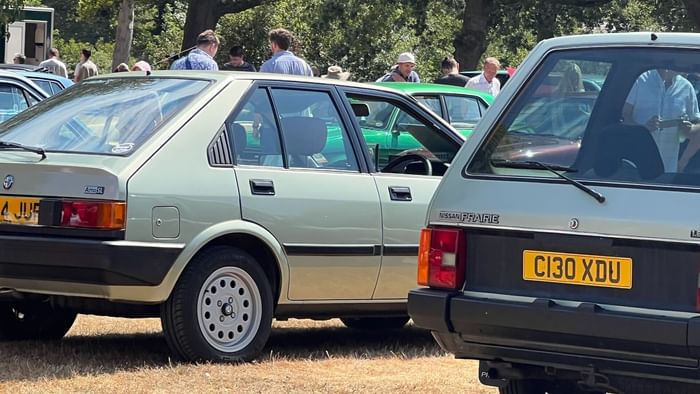
That could only be the Alfa Romeo Arna. Few vehicles have managed to disappoint two nations simultaneously: Italy supplied the passion and Japan supplied the reliability, but the resulting compromise somehow misplaced both. The Arna answered a question nobody in their right mind had dared to ask: ‘What if a Nissan rusted like an Alfa?’
Even today, automotive historians remain uncertain whether it was a bold industrial experiment, a simple administrative misunderstanding or a clash of cultures that lasted a few years. Its styling is pure 1980s Nissan blandness and suggests that somebody described an Alfa Romeo over a poor telephone connection before a committee finalised the drawings.
The interior has all the romance of old municipal office furniture. Yet somehow, people love them. The few surviving examples represent determination bordering on heroic insanity. Some people even turn humble, unsuspecting and utterly forgettable Pulsars/Cherrys into Arnas. Finding replacement parts has become less a hobby and more an archaeological expedition. Owners discuss corrosion with the vocabulary of structural engineers.
Every successfully restored Arna deserves its own documentary narrated by David Attenborough: ‘Against overwhelming odds, this rare specimen has reached adulthood.’
A magnificent display of forgotten normality
All over the place were Austin Maestros in colours resembling cold tea, Vauxhall Cavaliers whose velour seats remained suspiciously pristine and four-speed, low-spec Ford Sierras with wheel trims once advertised as ‘sporting’, all of them long since saved from banger racing.
Not forgetting the pre-Micra OAP favourite: the DAF-derived Volvo 340, ideally in Variomatic form, which attracted photographers because… it still retained its original dealer keyring. Children wandered around asking why every car was brown, while their parents simply sighed: ‘It was the eighties, darling; we were bold and young.’
Elsewhere, Cowley-built Rover 75s proudly displayed their black sills like talismans.
Verging on the anorakish
One of the most entertaining spectacles was listening to owners discuss production numbers. Supercar enthusiasts boast of ‘one of only 25’ examples built. Festival of the Unexceptional enthusiasts casually mention that theirs is one of only three surviving Peugeot 305 estates, fitted with dealer-installed mudflaps supplied on one particular Tuesday in October 1984.
All of a sudden, everyone becomes intensely interested. This level of obscure knowledge should probably qualify as PhD research for the University of Cambridge’s Department of Social Anthropology.
A wonderfully understated concours
Instead of asking which restoration cost the most, the judges admired period tax-disc holders, original radio aerials, untouched vinyl roofs and faded, genuine dealership number plates. One car gained extra admiration because it still carried a 1993 AA route planner in the glovebox; another contained unopened Werther’s Originals from 1996.
Authenticity matters, and the car park outside the small concours area became an extension of the show. Modern EV crossovers on PCP sat nervously beside 35-year-old family hatchbacks that somehow looked more honest, despite requiring a dab of choke on cold mornings. While electric SUVs promise software updates, the Bluebird promises that every switch still works, the Tagora promises French dignity and the Arna guarantees tetanus.
As the afternoon wore on, Spilt Milk struck up Jamiroquai’s “Cosmic Girl” – an entirely appropriate choice for a field full of 1990s cars – and the awards were announced. At the heart of the show, 50 cars had been selected for the Concours de l’Ordinaire on the lawn in front of Grimsthorpe Castle, representing the finest mundane motors still on the road.

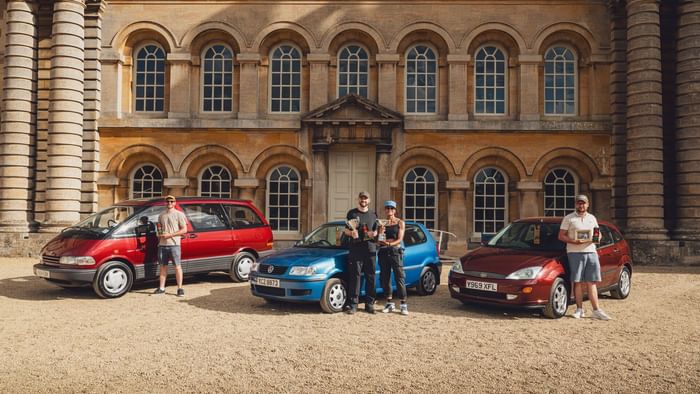
They were judged by automotive legends Steve Cropley, Steph Hoy, Richard Bremner, Jesse Billington, Antony Ingram, Gary Axon and Jon Bentley. After much deliberation and polite argument, Gordon McNeill and his 176,000-mile 2001 Volkswagen Polo E took first place; Matt Swinn’s 1992 Toyota Previa was second; and Jake Seddon’s 2001 Ford Focus came third.
Here, nobody wins for outright beauty or ultimate performance. FOTU trophies celebrate persistence, preservation and the remarkable achievement of keeping utterly ordinary cars alive long after economics suggested otherwise. It is impossible not to admire these enthusiasts as they rescue the forgotten middle pages of automotive history with the zeal of knights on a medieval holy quest.
Not every classic can be a Jaguar E-type or an MGB. Some have to be company cars driven by regional sales managers with sample cases in the boot. Those stories deserve preserving too.
A great simple truth
Visitors leaving the 2026 Festival of the Unexceptional could not help but realise something rather wonderful: the greatest classics are not always the fastest, rarest or most glamorous. Sometimes they are simply street-furniture cars that ordinary people trusted to take the children to school, go on family holidays to Cornwall, survive endless commutes and faithfully return home every evening without ever expecting applause.
Thirty or 40 years later, applause is exactly what they receive. Somewhere on the grass sat an immaculate Lada, a stubborn Yugo and a surprisingly intact Metro, proving that being exceptional was never the only route to becoming memorable.
Photos © Hagerty and Dimitri Urbain