Defeat your heroes: Land Rover Defender – off-road legend, on-road ordeal
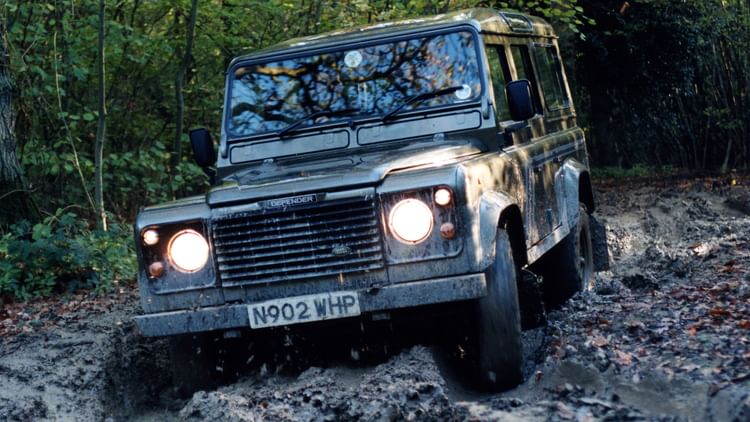
Few vehicles have enjoyed the mythology of the Land Rover Defender. It is spoken of in reverent tones by enthusiasts who praise its ruggedness and its stubborn refusal to modernise.
This is the second in a new occasional series in which Alex Wakefield and fellow cynic Dimitri Urbain take aim at cars that enjoy near-mythical status in motoring culture. These are not balanced buying guides or nostalgic love letters. They are opinion pieces, written with a raised eyebrow and sharpened pencil.
For many, the Defender symbolises the spirit of exploration, and that reputation has been amplified by glossy advertisements and Camel Trophy narratives, not to mention the enduring romance of British automotive nostalgia.
Defeat your heroes
Exhibit two: The Land Rover Defender
Strapline: The best 4x4xFar
Factfile
- Production: 1990-2016 (roots in the 1983 90 and 110)
- Bodystyles: Two- and four-door in pickup, soft-top, and hard-top guises, plus countless specials such as Wolfs and fire engines
- Engine size: 2.5-3.9 litres
- Transmission: Four-, five- and six-speed manuals, plus four-speed automatic
- Number built: Approximately two million
- Current status: Unimpeachable

The case for the persecution
Strip away the haze of sentimental hero worship and the flawed Defender of this era is revealed: a poorly engineered, astonishingly uncomfortable, chronically unreliable relic that survived far longer than it deserved.
Here, we confront the reality of a vehicle that spent 26 years being forgiven for flaws that would have sunk any less mythologised machine in no time. We need to deliver an unsparing critique of the Defender’s supposed brilliance, built upon decades of headaches, breakdowns, ergonomic crimes and marketing-driven delusions.
Let’s take a look at the evidence
The biggest lie in the Defender’s legend is that it’s indestructible. Anyone who has actually lived with one long-term – not the polished museum pieces, not the Instagram-prop overlanders featuring a roof tent, not the weekend-warrior hobbyists – will tell you the truth: Defenders break constantly, spectacularly and sometimes even creatively.
Keeping a box of spare parts and tools on board feels less like prudence and more like a dysfunctional relationship survival kit. The ladder frame is sturdy, and the off-road geometry is genuinely excellent. But what good is a strong skeleton when the organs are failing weekly? When owners say a Defender ‘marks its territory’, it isn’t humour but an admission of mechanical incontinence.
Durable in the sense that a hammer is durable? Perhaps, but the hammer doesn’t expect you to spend thousands of pounds on it annually just to keep it hammering. The engineering was always stuck in a time capsule: the 1990-2016 Defender was really a lightly updated 1980s vehicle built around 1950s design principles, resisting modernisation like a stubborn mule.
Whatever the engine, none achieved power, refinement and reliability, with the possible exception of the BMW M52 straight-six fitted for the South African market. Owners had to choose two qualities at best and often received only one. The gearboxes were medieval and comically fragile; the driver’s experience was akin to stirring a pot of rocks with a broomstick.
Finding gears was an act of faith, and keeping them engaged an act of hope. Drivers described the shift feel as shovelling coal, buttering toast with a crowbar, or putting a box of spanners in a washing machine.
How about the chassis?
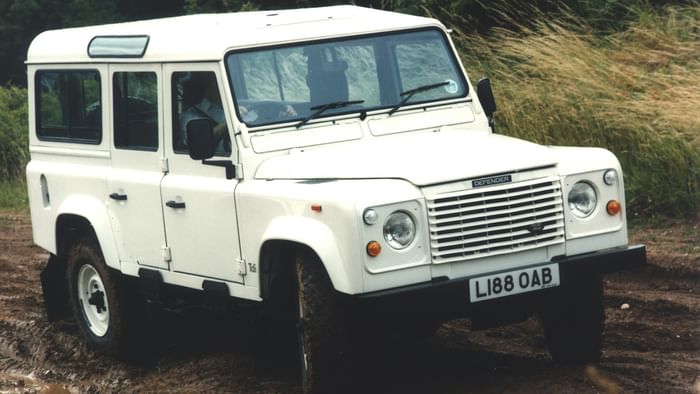
The live axles, ancient though they are, offer good articulation off-road. On the road, however, the suspension doesn’t absorb impacts so much as transmit them straight into your spine. Long drives become chiropractic emergencies, while calling the Defender’s brakes ‘adequate’ would be heroic in itself. It stops… eventually.
What’s inside, then?
The Defender’s interior is famously cramped, although ‘cramped’ is too gentle a word. ‘Structural torture chamber’ is closer to the mark. The driving position is an ergonomic cold case, and the pedal box is so narrow that even average-sized shoes overlap. The steering wheel sits slightly off-centre, as if Land Rover’s engineers simply gave up halfway through aligning it.
Drivers sit upright, legs askew, head brushing the roof, shoulders wedged against a flat door and alarmingly close to the window. The Defender accommodates humans the way a medieval suit of armour fits a horse.
The leaky doors ensure the cab is always half freezer and half steam bath, depending on the weather and mood. Noise levels approach those of industrial machinery, making earplugs essential, practically compulsory.
Build quality: rustic or just poor?
The Defender’s build quality achieved a rare combination of flimsiness and over-engineering. Panels rarely align, doors don’t seal, and bolts come loose at random. The dashboard wobbles, apparently by design. Gaps are wide enough to admit daylight, rain, dust and occasionally wildlife.
Closing a door requires the force of a battering ram and a saint’s optimism. Aluminium panels resist corrosion, but the steel frame beneath them does not. No Defender is truly a Defender without at least one electrical problem occurring weekly.

Off-road legend… with an asterisk
Its off-road prowess is real: articulation is impressive, and low-range gearing ensures slow, technical terrain is manageable. Many Defenders completed expeditions because their owners carried belts, hoses, large quantities of fluids, an extensive toolkit, and, above all, deep faith in their own mechanical abilities.
Safety? What safety?
Land Rover loyalists, those defenders of the Defender (pun intended), like to dismiss safety concerns with poetic lines such as ‘It’s built like a tank’. It isn’t. It is a metal shed on a ladder frame.
It has virtually no modern safety features; no airbags, no credible crumple zones and no traction or stability control. Calling the Defender unsafe is not vitriol but an objective assessment.
Summary
Stripping away nostalgia and romance, the 1990-2016 Defender is revealed as outdated before it was even introduced, unreliable to the point of comedy, ergonomically hostile, poorly assembled, and dangerous by modern standards – kept alive by image more than function.
The Defender deserves to be remembered rather than blindly worshipped. It is an icon for cultural reasons largely unrelated to engineering excellence. If you still think it is the greatest off-road vehicle ever made, drive a Toyota Land Cruiser and reconsider your life choices.
Humans love stories, and the Defender is a narrative on wheels. Breaking down in one becomes a badge of honour, and repairing it in the rain or snow by the roadside a rite of passage. Suffering creates loyalty, and Defender owners suffered enough to become truly fanatical.
All images © Land Rover