Some cars are so deeply woven into enthusiast folklore that questioning them feels almost rude. Almost.
This is the first in a new occasional series in which Alex Wakefield – joined later by fellow cynic Dimitri Urbain – takes aim at cars that enjoy near-mythical status in motoring culture. These are not balanced buying guides or nostalgic love letters. They are opinion pieces, written with a raised eyebrow and sharpened pencil.
First up: the Ford Capri. If this offends you, there are many Capri Facebook groups waiting with open arms.
Have you noticed how the Ford Capri (the mediocre coupé of the ’60s, ’70s and ’80s, not the nice new electric one) has suddenly become the apple of every proud Englishman’s dewy eye?
Together with an apparent rediscovered fondness for the St George’s Cross and upside-down Union Flag, you’ll find that there are now many who will claim that the Capri should be placed on a pedestal, to record its place in history as the best mid-century car ever to grace our roads.
The cynical among you might think that this is related to a blue-collar aversion to anything battery-powered, and manufactured rage because Ford (FAHWD) decided to name its new BEV car after the ropey coupé I’m about to take aim at.
That Capri EV, by the way, is a thoroughly decent car. One which would absolutely run rings around even the most hairy-chested version of its nearly sixty-year-old namesake in any challenge (yes, including real-world range), but that’s another story.
Time heals. Specs become rose-tinted. The Capri has become a good car. It’s time to challenge this recent finding and, in a series of attacks on cars held to have god-status, my cynical colleague Dimitri Urbain and I are going to use Petrolblog to:
Defeat your heroes
Exhibit One: The Ford Capri
Strapline: The Car You Always Promised Yourself
Factfile:
Production: 1969-1986
Bodystyles: Coupé
Engine size: 1.3-5.0-litre
Transmission: 4-speed manual, 5-speed manual, 3-speed automatic
Number built: 1.9 million (approximately)
Current status: Anglo-Saxon God
The case for the persecution
Not only was the Capri until very recently considered to be a laughing stock, it deserved this reputation. Although nearly two million were sold, the vast majority of them were equipped with wheezy four-cylinder boat anchors, rendering them a sort of less practical Cortina.
Updates in styling did nothing to address the fundamental issues with a car born nearly six decades ago. The last ones took three years to sell, and by the time production ended, they were an embarrassment to the Blue Oval.
The Capri does not deserve to be held in high regard. Just ask Del Boy.
Let’s take a look at the evidence:
We will start at the end of the sorry Capri saga. In 1986, long after the model should have been killed off, Ford’s Cologne factory built 1,038 examples of the Capri 280, which was to be the final model off the line. All were painted a really rather fetching shade of ‘Brooklands’ green, fitted with a 2.8-litre V6, limited-slip differential and a five-speed manual transmission.
All of those cars were right-hand drive, and all of them were destined for the UK. Not a single Capri had been sold anywhere else since 1984, with the British Isles remaining the only market for a car needing to be put out of its misery. Realising it needed to use up the last bodyshells, Ford sprayed them green, used the last decent components and punted them out across dealer forecourts.
Three years later, the last new car sold. Rumour has it that there are a small number which were never registered, presumably in the hope that one day the world would realise how great the over-ripe, underpowered, leaf-sprung, live-axle-suspended coupé actually was. Yes, the Capri everyone wants was a flop.
Those last cars were built nearly forty years ago. Most of those forty years have not been kind. The ravages of time, rock salt, wear, tear, and the limitations of the ancient underpinnings – in the hands of drivers who thought the words ‘Ford’ and ‘Capri’ meant the car would actually do what it was told – have ensured survival rates are low.
Through the 1970s, ’80s and ’90s, the Capri earned itself an image which will never be shaken off. While handbrake turns and bonnet-sliding antics in The Professionals were undoubtedly great fun, most will remember the car’s association with Terry McCann and Derek Trotter more keenly. Those televisual rogues may have been lovable, but they had dubious taste in fashion, livelihoods and vehicles.
Essex Girls. Stilettos. Chest wigs. Sovereign rings. Ford Capris.
Here, we should call on some actual data to support these accusations. How Many Left is absolutely not a source of reliable data, but a quick scan reveals that of the survivors in the UK, the vast majority are fitted with four-cylinder engines.
Those four-pots varied in displacement from 1.3 litre to 2.0. In various states of tune, both overhead-valve and overhead-cam, they had in common one thing: they were awful. Positioned in the engine bay, under the bonnet clearly intended to compensate for the driver’s reproductive failings, a four-cylinder motor looks like it has been dropped in by mistake.
Given that even the V6-equipped versions mustered a maximum 160bhp, those behind the wheel of a lowly Capri GL, Laser or Cabaret must have spent their lives pretending not to be disappointed by their wheezy, underpowered, cart-sprung cars. The experience would never have lived up to the promise. Having been left behind at the traffic-light Grand Prix by more modern competition, and out-handled on B-roads by its contemporaries, it would have been a relief to finally be caught out by the live axle on a greasy road and roll into a ditch.
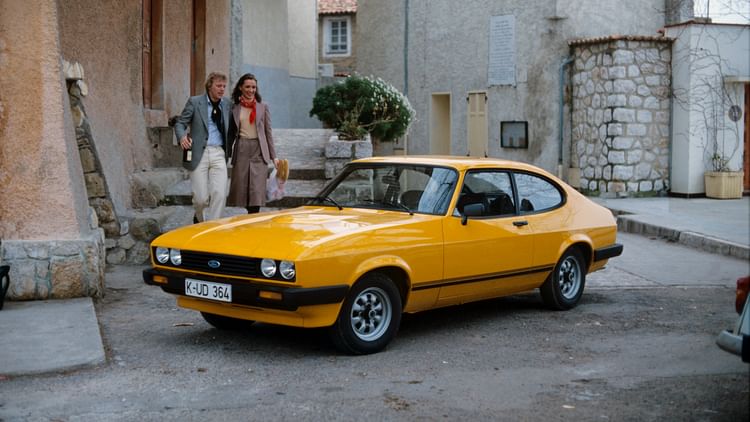
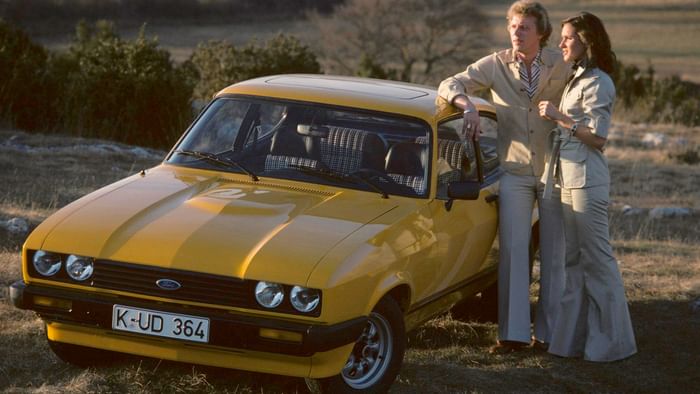
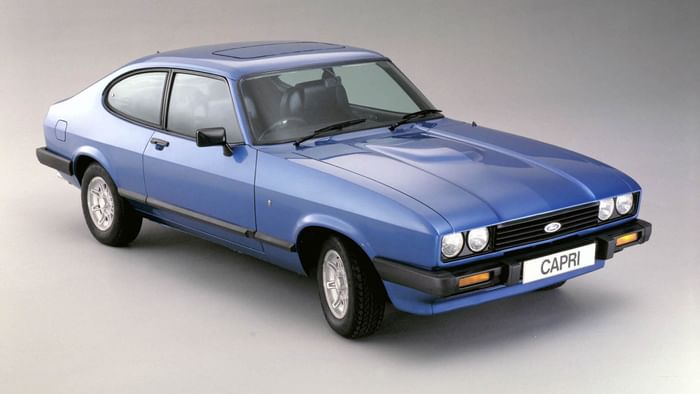
For those calling for the head of the Capri EV on a plate, this was the experience most had with the original car. Disappointment, acknowledged or otherwise, behind the wheel of a dated, flawed, impractical and agricultural machine, wrapped up in a nice bit of metal. I’ll concede that the Capri coupé (I have a fondness for the appearance of the last version with four round headlights) looked alright, but that’s where the talent started and finished.
It was a decent lash-up in the 1960s when it first appeared, but twenty years later it was a joke. Perhaps the biggest surprise about Ford’s use of the name for its new EV is that it felt the dust had settled. Most customers for the latest car would have been born after the last 280 wheezed off the line in Cologne, and have only negative associations with the model – if they remember it at all.
Summary
The rose-tinted specs seem to get rosier. The Capri was a dud. I rest my case.
All images © Ford.