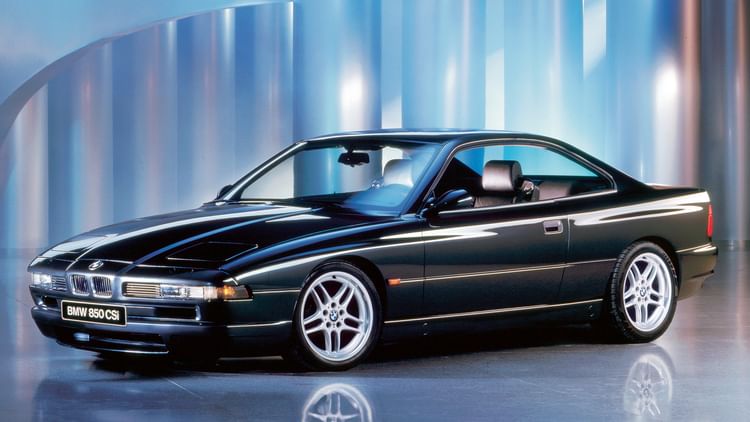
Pity BMW’s hubris. 1989’s E31-series 850i was an engineering masterpiece, but the critics said it lacked soul. The later 850CSi righted many of these wrongs, but desperate owners of lesser 8ers – possibly with buyer’s remorse – sought to talk up the pedigree of their engines with outright lies.
At the heart of this problem was the V12 itself; an engine which, as the 5.0-litre M70, had first appeared in the E32 7 Series saloon in October 1987. Its development had slowed the launch of the E32 itself: at the eleventh hour, before its design was signed off, chief engineer Wolfgang Reitzle called for the car to be widened by 40mm to accommodate said V12.
The stakes were never higher, with senior executives reasoning that, if the E32 failed, BMW would withdraw from the large executive saloon segment to concentrate on its 3 and 5 Series.
To that end, BMW couldn’t ignore the prestige of a V12 any longer. Ferrari, Jaguar and Lamborghini aside, few European marques kept such an indulgent design in their catalogues; last seen in domestic German cars at the outbreak of World War 2, Dingolfing had to get out in front of Mercedes-Benz. Convinced that its new S-Class would sport a V12, BMW realised its upcoming M40 four-cylinder – a belt-driven, overhead-cam replacement for the storied M10 – would make an excellent basis for the M70, designing it alongside the junior engine to share certain tooling and parts.
No, it wasn’t two 325i M20s sharing a common crankcase, and no, BMW did not farm development out to AVL of Linz, Austria, despite what you might have read online. Given the growing resentment towards performance and luxury cars, BMW knew that 32-valve V8s (also reintroduced in the E32) were the better compromise.
To stick one up Mercedes-Benz, however, a V12 needed to exist, as soon as possible, and in the most expedient way: to that end, the M70 used the M40’s bore spacing, but used a timing chain rather than the M40’s belt, and had two valves per cylinder. It also derived its finger-type rocker arms, valves and conrods from the smaller engine.
The undersquare M70, with an 85mm bore and 75mm stroke, displaced 4988cc in its first configuration: in an industry first, it used fly-by-wire throttle, eliminating the connection between the accelerator pedal and the inlet manifolds.
With an 8.8:1 compression ratio, its 300bhp (magazines quoted between 292 and 296 depending on dyno) outpaced Benz’s incumbent 5.6-litre V8 in the 560SEL, and Jaguar’s 5.3-litre V12 in the XJ12 and Daimler Double Six. By 1987 standards, the M70 was top of the pile. For longevity, parts were duplicated per bank, to keep the car running with an adequate 150bhp should one half of the ‘V’ succumb.
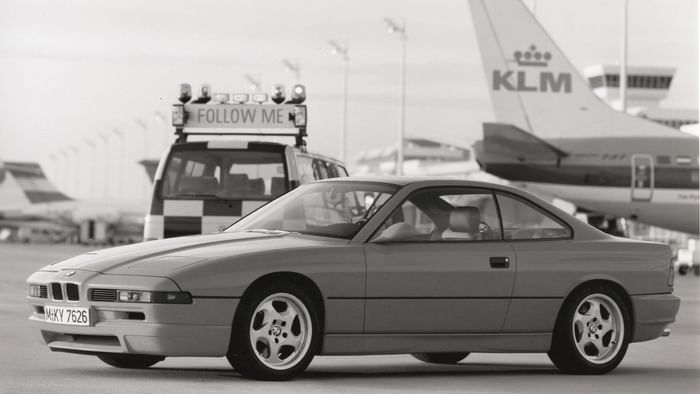
What of the 850i itself, then? BMW wanted an upmarket replacement – the grandest of grand tourers in the classical V12 sense – to replace the beloved E24 6 Series. A storied touring car, the 635 wore a CSi badge in Europe from 1984, when the M1’s reworked M88 six-cylinder was slipped under the bonnet.
At that point, the E24 6er had lived longer than any other BMW. Its partial replacement, however, was tilted squarely at Porsche’s 928, a one-time 911 replacement that too few people bought, despite winning Car of the Year in 1978. The powers of hindsight also realised that, by the early nineties, a recession was on the way.
Though deposits taken at the 1989 Frankfurt motor show accounted for three years’ worth of production, they quickly dropped away owing to the changing political climate. ‘The initial BMW (GB) waiting list has withered away, mostly because of the recession rather than any public perception of shortcomings in the 850i,’ wrote Jeremy Walton in Motor Sport, June 1991. UK buyers had had their first glimpse of the new car at September’s NEC the previous year.
The E31 was yet another victim of circumstance; the world’s crumbling finances meant that fewer people were interested in its many technical accomplishments.
It was the first BMW (and indeed the first V12 production car) to be offered with a six-speed manual gearbox (the Getrag 420G, from May 1990). Autocar’s 1991 850i was a scant 0.1 seconds quicker to 60 than its automatic equivalent; there were complaints either side of the Atlantic regarding driveline shunt, and the majority of 850 buyers (few though they were) plumped for the four-speed automatic.
Remember that six-speed gearbox, though. Not only did the later E31 850CSi use it, but the E34 M5 3.8 and E36 M3 did, too. The myths are right about the breeding, but the details are way off.
All dressed up, with nowhere to go: before the 850CSi existed, the press was cool as to the E31’s virtues. Klaus Kapitza’s shape wrote cheques the rest of the car couldn’t cash; a steeper rear window than the E24 (70 degrees versus 62) and cramped rear accommodation made it a strict 2+2, though its closest rivals either side of its price bracket (XJR-S, 928, 412 and 456) fared little better.
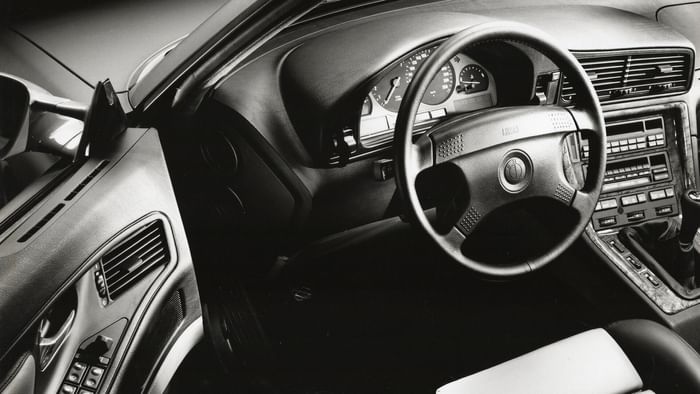
But this feature is about an engine – or, as we will soon discover, several engines. Slow sales of the 850i meant BMW canned plans for a convertible (which would have given it a direct rival to the R129 Mercedes-Benz SL) and a high-performance E31, the M8.
No, not a friendly motorway in Scotland: one M8 was built, with what turned out to be a unique engine – the S70/1, developed by BMW Motorsport. That ‘/1’ denotes a considerable amount of work over the M70. Accounts vary as to its exact power output, but with 48 valves, it displaced just under 6.1 litres (6064cc) and made at least 550bhp.
The confusion begins (and the tall tales start) when trying to determine the S70/1’s fate: when BMW Motorsport realised that the M8 was dead in the water, chief engineer Paul Rosche, a former colleague of Murray’s at Brabham, offered its engine to Gordon Murray. A chance encounter in the pit garages at the 1990 Hockenheim Grand Prix put the engine back into contention for Murray’s supercar project – what the world came to know as the McLaren F1.
Murray was struggling to find an engine that fit the bill; Honda declined, owing to conflicts of interest. The requirements were ambitious: following a further meeting with BMW Motorsport in Munich, the S70/1 didn’t qualify. Murray deemed the engine too heavy, too large – and not powerful enough. Given the new requirements, Rosche replied simply: ‘We’ll do a new engine,’ as recounted in Driving Ambition: The Official Inside Story of the McLaren F1.
The new unit, S70/2, owed nothing to the S70/1, though its displacement was identical. According to BMW Group Classic, which responded to a Jalopnik article on the M8, the S70/2 ‘from a design standpoint, shared quite a lot of characteristics [bore spacing] and parts with the S50 engine of the E36 M3.’
Sorry: your BMW 850i does not have the same engine as a McLaren F1. Nor does the aforementioned 850CSi, the critically acclaimed, sought-after 1992 flagship of the E31 range. M Division punched the M70 out to 5.6 litres, netting an 80bhp boost and a new name – S70B56 – to boot. 850CSis used M Division VINs, and were designated ‘M8’ in German homologation documents.
Confusion abounds. Some internal BMW files call the S70B56 ‘S70/1’ even though it’s a different engine – a production unit with 1510 built. In 1994, the now-humbled M70 became the 5.4-litre M73, having lived for just over six years: these models, which slotted below the 850CSi, were known as 850Cis from October 1994. Smaller V8-engined E31s – the 840 (4.0 litres from 1993-1995 and 4.4 litres from 1995-1999) also joined the range.
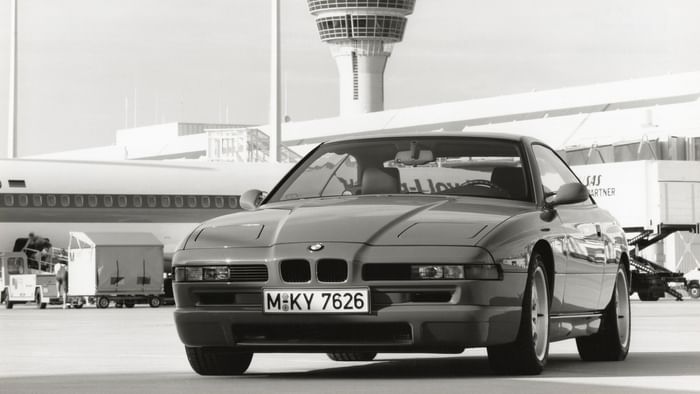
While it never found a home inside a certain mid-engined British supercar, the M70 did enjoy a fleeting career beyond the 7er and 8er. In early 1989, it was mooted as a possible replacement for the ill-fated Cizeta Moroder’s V16 engine by tuner Uwe Gemballa, as the partnership between Claudio Zampolli and Giorgio Moroder soured.
By 1991, Italdesign had turned its still-born Bugatti ID90 into a BMW – the Nazca M12 – and the M70 sat behind the driver. As the bubble economy turned to recession, killing said M1-successor-in-waiting, five more mid-engined V12 BMWs headed into the annals of history: the 1992 Nazca C2 Coupé (M70 tuned by Alpina) and the Nazca C2 Spider of 1993, which used the 850CSi’s S70B56. Three copies are said to have been built after the show lights were switched off.
None of the tall tales about BMW’s first production-car V12 rang true, but the layout continued to flourish in newer iterations. The M73 (in TUB54 specification) powered the short-lived Rolls-Royce Silver Seraph until 2002, while its successors, N73 (and latterly N74), power Royces to the present day.
Quite the origin story, then – but the tall tales shared around the internet are best ignored.
Originally published in Classic.Retro.Modern. magazine (issue 37). Images courtesy of BMW.