Fiberfab Sherpa: Germany’s attempt at a Méhari (but with fewer leaks)
The 2CV was always something of an ugly duckling in Germany. Back in the 1970s and ’80s it became the transport of choice for Green Party activists, especially in bright colours. A huge Solar Energy or ‘Raketen? Nein, danke’ (‘Missiles? No, thanks’) sticker on the bootlid was practically de rigueur.
It simply wasn’t fast enough for Autobahn life: any passing S-Class, 911 or even a humble Ford Taunus could make it wobble on its wheels as it was blasted by at least three different slipstreams.
The Méhari, however, could have been genuinely useful. Speed is irrelevant off-road, and its sensational roadholding would have made it great fun on the rough stuff. Unfortunately, it was never homologated for the German market. Citroën couldn’t get it past the TÜV, which objected to the ABS plastic body’s low burning point. An independent importer managed to sell a handful in 1972, but the whole thing was eventually shut down.
Fiberfab enters the scene
Fiberfab was an American company specialising in cheap – often very cheap – kit-built replicas of classics (GT40, MG TD, 356… take your pick) and dune buggies based on a stock or shortened VW Beetle platform. Its German subsidiary slowly grew into its own thing and identified a ripe opportunity: a simple, no-frills off-road leisure vehicle for the German market. Very sensible. Very humourless. Very German.
Back in the 1970s the off-road options were limited. You had dune buggies at one end and rugged 4x4s like Land Rovers or Land Cruisers at the other. There was obvious space for something alongside the VW 181: essentially a 2CV-based Tupperware alternative. So Fiberfab launched the Sherpa at the 1975 Frankfurt motor show.
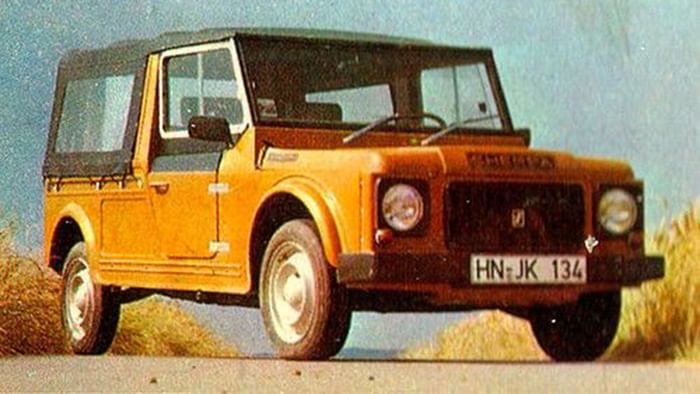
Its square, utilitarian lines were very similar to the Méhari’s, with seating for four and decent luggage space. What made it better? For a start, a proper, non-leaking roof. A standard Méhari hood is always full of holes and lets in water at the first hint of rain; Fiberfab fixed that with admirable German efficiency.
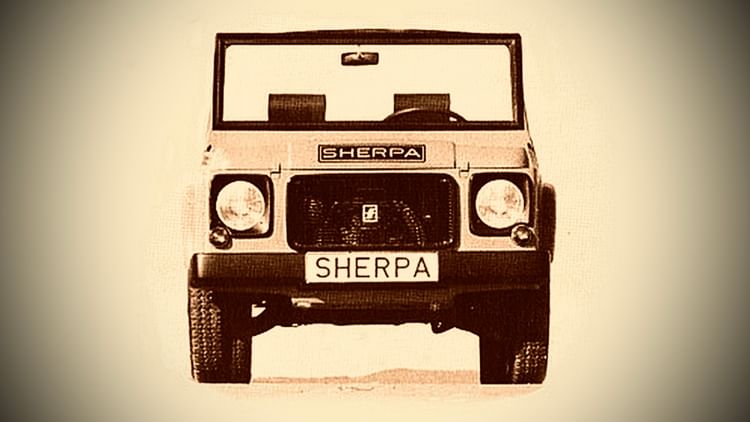
The Sherpa also had a distinctive front end with large round headlights. In fact, it looked closer to the US-spec Méhari than the French one, Citroën having originally developed that version for the US Army, which then declined to take it. The cars were shipped back to Europe and converted to Euro-spec at Citroën’s Brussels plant.
Fiberfab offered a healthy list of extras, making the Sherpa a little more upmarket than its French cousin: a plastic hardtop, posher seats with headrests, or even a winch.
A failure
The Sherpa was sold in kit form from 1975 onwards. It used a complete 2CV chassis with the standard 602cc air-cooled flat-twin engine. Fiberfab claimed it could be assembled in just five hours with simple tools, assuming the body of the donor 2CV was already off the chassis. In reality, kit cars of this type never really caught on in Germany. Just like the famous 1960s Lotus Elan you were supposedly able to build with a few friends and many beers over a weekend, the Sherpa inevitably took longer to finish and sort for the road.
By 1982, around 250 kits were believed to have been sold across France (supposedly…), the Netherlands, Germany and the UK. But it was soon killed off by the arrival of the Lada Niva and Suzuki LJ80: cheap, tough, genuinely capable off-road, and proper 4x4s.
Photos courtesy of Citroënët and Dimitri Urbain