Parts-bin raiders: ten groups of cars with shared secrets
Badge engineering never went away, and shared components reach further than you might think. Here are ten pairs, trios and families from the 1990s to the 2010s that share platforms, engines or parts – and the boring strings of letters and numbers that help give the game away.
Toyota, Peugeot and Citroën invested around €1.3 billion in developing three small cars and establishing production at a factory in Kolín, allowing three dealer networks to sell essentially one car with three faces. That is the obvious version of badge engineering. Less obvious are the shared components hiding beneath cars that look nothing alike.
Parts catalogues reveal connections that the badges don’t advertise. Sometimes the same component carries one part number across several brands. Sometimes each manufacturer gives it a different number, leaving a cross-reference to reveal the relationship. Either way, the badge tells only half the story. The number is the useful bit.
The Czech triplets and the Portuguese people carriers
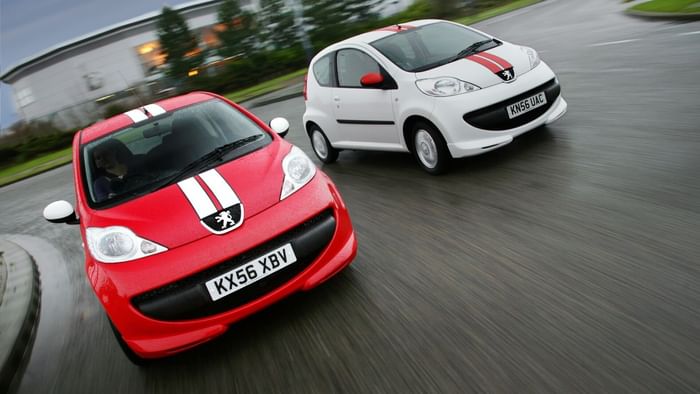
1. Toyota Aygo, Peugeot 107 and Citroën C1 (2005 to 2014)
Toyota’s press release from 31 May 2005 is refreshingly candid: all three were built on a common platform at the TPCA plant in Kolín, which had an annual production capacity of around 300,000 cars.
One giveaway is the OEM part number, which helps identify a component and its equivalents across different brands. The right-hand front electric window regulator, for example, is listed under Toyota number 69810-0H010 and PSA number 9222.T6, with applications across all three models.
Different badges, different numbers, a shared replacement part. It pays to compare prices before deciding which badge belongs on the box.
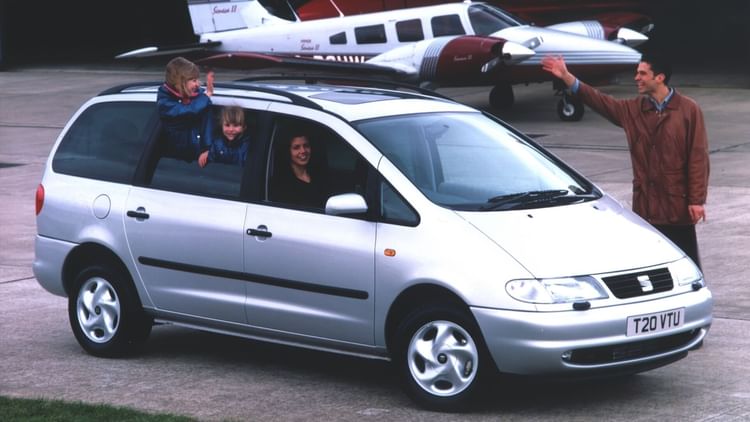
2. Ford Galaxy, Volkswagen Sharan and SEAT Alhambra (first generation)
The first Galaxy came out of Autoeuropa in Palmela, a factory established through a joint venture between Ford and Volkswagen. Ford’s involvement in the joint venture ended in 1999, although Galaxy production continued there until 2006.
The Galaxy’s 2.8-litre VR6 and 1.9-litre TDI engines came from Volkswagen, despite the Ford badge on the bonnet. The connections extend to smaller components: left-hand mirror glass carrying Volkswagen number 7M0 857 521 E is listed for versions of the Galaxy, Sharan and Alhambra.
If your local Ford specialist draws a blank, the Volkswagen specialist around the corner may recognise the number.
The posh badges and their everyday relatives
3. Jaguar X-Type and Ford Mondeo Mk3
Built at Halewood, the X-Type used a platform derived from the Mondeo’s. That didn’t make it simply a Ford with a Jaguar grille, but it did mean some less glamorous components had familiar origins.
Take the heater matrix. Ford reference 1S7H18476AA and Jaguar reference C2S4781 appear in cross-reference lists for the same replacement unit.
Same job, two labels. Before paying extra for the leaping cat on the invoice, it is worth checking the alternatives.
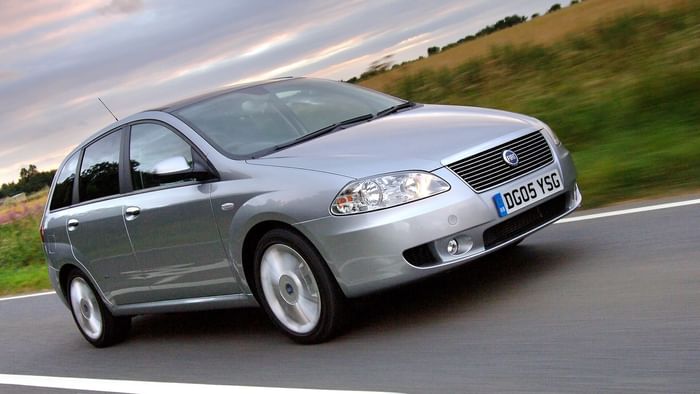
4. Saab 9-3, Vauxhall Vectra C, Fiat Croma and Cadillac BLS
These cars belonged to the GM Epsilon platform family, although their styling, engines and equipment varied considerably.
Certain versions also shared air-conditioning components. Replacement compressors are cross-referenced against OE numbers including 24411249 and 13140505, with applications spanning Cadillac, Fiat, Opel, Saab and Vauxhall.
The engine and compressor specifications still matter, but a Saab owner who checks the equivalent Vectra listing may find another route to a cooler summer.
5. MG ZR and Rover 25 (2001 to 2005 for the ZR)
One of the clearest relationships on this list. Longbridge gave the ZR sportier suspension and a body kit, while the Rover 25 offered a more restrained interpretation of the same basic car. Both remained in production until MG Rover went into administration in April 2005.
The parts-sharing extended well beyond this pair. K-series camshaft LGC106960 is listed for selected versions of the Rover 25, 45 and 75, plus the MG ZR, ZS, ZT and TF. There are exceptions, including particular VVC and TF applications, so the engine specification matters.
Nobody at MG Rover had much reason to hide the family resemblance. The useful distinction is between engines, rather than badges.
The Dutch connection, the Prince and a Polish Ford
6. Smart Forfour and Mitsubishi Colt (2004 to 2006 for the first Forfour)
NedCar in Born, in the Netherlands, built both cars. The first Forfour shared its platform and numerous components with the contemporary Colt, including Mitsubishi petrol engines.
The front ball joint provides a neat example. Mitsubishi reference MN186217 and Smart reference A4543330127 are both cross-referenced to BGA replacement part SJ8202.
Different numbers, one replacement component. This is why a useful parts search cross-references manufacturers’ numbers rather than simply looking for an identical string of characters.
7. MINI R56 and Peugeot 207
BMW and PSA’s jointly developed Prince engine family appeared in 2006, with MINI engines assembled at Hams Hall.
The N14 in the MINI Cooper S and the turbocharged 1.6-litre EP6 variants in the Peugeot 207 share more than a reputation for timing-chain trouble. Replacement timing-chain kits can list PSA references such as 0829 G3 and 0816 H9 alongside BMW reference 11317534833.
That doesn’t mean every kit fits every Prince engine. It does mean the badge on the bonnet needn’t dictate the badge on the parts box.
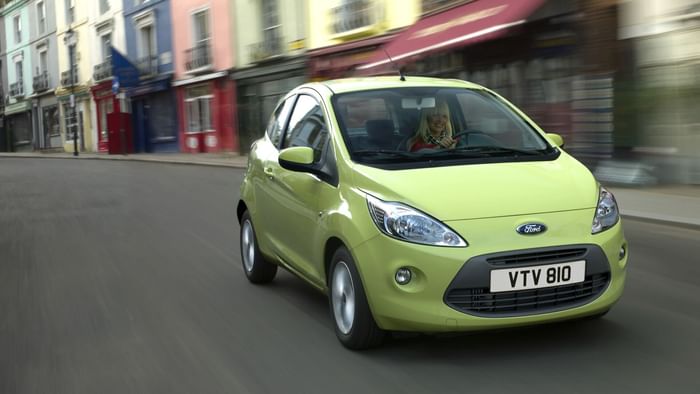
8. Ford Ka Mk2 and Fiat 500 (2008 to 2016 for the Ka)
The second-generation Ka was built at Tychy in Poland alongside the Fiat 500, sharing its basic architecture with the 500 and second-generation Panda. Its 1.2-litre petrol engine was a member of Fiat’s FIRE family.
The shared components weren’t confined to the engine bay. Brake servo number 51838695 appears in listings for the Ka and certain Fiat Panda versions.
The 500 may have won the fashion contest, but the Ka’s Fiat connections can be useful when it is time to search for spares.
Japanese factories, different badges
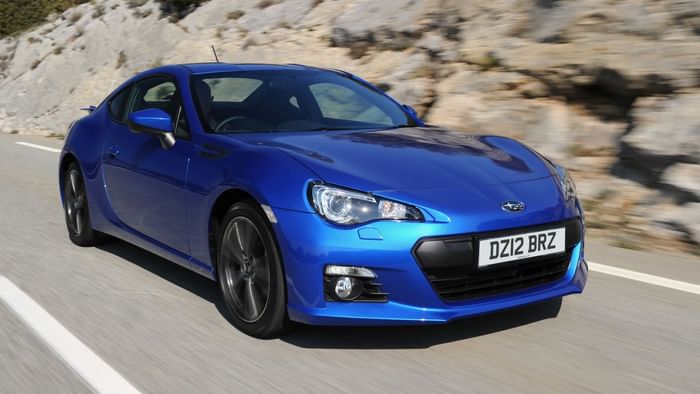
9. Toyota GT86, Subaru BRZ and Scion FR-S (first generation)
Production of the jointly developed Toyota GT86 and Subaru BRZ began at Subaru’s Gunma Main Plant in Ota in March 2012. In North America, the Toyota version initially wore Scion FR-S badges.
The shared origins extend to the bracketry. Toyota references SU003-01498 and SU003-01499 identify front bumper side brackets listed for the GT86, BRZ and FR-S.
Those are Toyota references for shared components, rather than proof that Subaru used identical part numbers. Cross-referencing the equivalent Subaru part is the useful next step – followed by a price comparison.
10. Citroën C-Zero, Peugeot iOn and Mitsubishi i-MiEV
The C-Zero and iOn were Mitsubishi-built versions of the i-MiEV, produced at the Mizushima plant in Kurashiki. Early European versions used a 16kWh battery and a 47kW motor.
Their shared hardware includes the front brake discs. Replacement listings for the 257mm discs cross-reference PSA number 4249 L5 with Mitsubishi number 4615A093.
Searching under all three badges can broaden the choice, but the part number and vehicle specification are the better starting point. Tools such as Autoparts24’s OEM search can help uncover those connections. The badge may catch your eye; the number helps you find the part.